

Sculptural Ceiling Lighting: Make the Fifth Wall Work
Sculptural ceiling lighting gives a room a focal point overhead, where an expressive form can shape the view even when the light is switched off. The best choice is not simply the most dramatic fixture: it is the one that fits the room’s scale, clears important sightlines, casts useful shadows and leaves other objects room to breathe.
Contact us with your lighting question
What is sculptural ceiling lighting?
Sculptural ceiling lighting is a ceiling-mounted fixture chosen for its form as well as its illumination. It might be a pendant, chandelier or flush-mounted design. Its silhouette, material, color and arrangement become part of the room’s architecture. The fixture can act as a focal point, repeat a shape already present in the space, or add a counterpoint to a restrained interior.
That does not mean every expressive ceiling light has to dominate. A branching fixture may feel airy because you can see through it. A broad, solid shade may read as a stronger visual mass. A small fixture can still feel sculptural when its outline is distinctive and the surrounding ceiling is quiet. Think of the fixture as an object in the room and as a source of light at the same time.
Ceiling fixtures also have a different job from table and floor lamps. They are viewed from across the room and from below, and they help establish the room’s overall composition. Portable lamps add lower pools of light and can be moved as needs change. For a closer look at those forms, see the Woaw Lighting Collection buying guide.
How do you choose sculptural lighting for a ceiling?
Start with the room’s purpose and the fixture’s role. Is it meant to draw attention to a dining table, define the center of a living room, or provide a quieter layer of general light? A statement fixture can do more than one thing, but deciding on its main job helps narrow the shape, size and light distribution.
Then look at the room as a whole, not only at the ceiling. Note the furniture footprint, ceiling height, window and doorway positions, and the strongest objects already in view. Consider whether the fixture should echo a curve or color in the room or introduce a new shape. The aim is a deliberate relationship, not a room where every object tries to be the headline.
Finally, check practical details before choosing a design: the mounting location, the required electrical connection, the manufacturer’s installation instructions, and whether the fixture’s dimensions suit the room. For installation and electrical work, follow local requirements and use a qualified professional when needed. A beautiful shape cannot compensate for a fixture that is difficult to install or uncomfortable to live with.
How should ceiling fixture scale relate to the room?
Scale is about more than the ceiling’s height. Compare the fixture with the furniture beneath it, the size of the room, and the amount of visual activity around it. A large open form can read as light despite its width; a compact opaque shade can feel weighty. Product dimensions are useful, but seeing the outline against a room photograph or a paper mock-up can make the choice easier to judge.
Try this simple planning exercise before ordering:
Measure the area the fixture will occupy, including any table or seating group it should visually relate to.
Mark the proposed footprint on the floor with painter’s tape, or cut a paper circle or shape to the approximate width.
View that outline from the doorway, from the main seats and from nearby circulation routes.
Ask whether it feels present enough to anchor the area, while leaving the surrounding architecture and furniture legible.
These checks are visual aids, not universal size formulas. Two fixtures with the same width can feel entirely different because one has open arms and the other has a solid shade. Likewise, a high ceiling does not automatically call for the largest possible design. A tall, narrow room may need a fixture with a vertical profile; a broad room with a low ceiling may benefit from a more horizontal, visually open silhouette.
For a fixture over a table, compare its shape with the tabletop. A long table may suit a linear composition or repeated forms, while a round table often makes a central silhouette feel intentional. Keep the relationship clear without letting the fixture crowd the people or objects below it. If the fixture is not centered over furniture, check that the offset looks purposeful from the room’s usual viewpoints.
Which ceiling fixture format suits the space?
Different formats make different visual promises. Use the comparison as a starting point, then check the actual dimensions, light direction and mounting needs of any specific design. Names such as “pendant” or “chandelier” do not guarantee a particular brightness or spread.
FormatVisual characterUseful whenCheck before choosingPendantA distinct shape suspended below the ceilingYou want to mark a table, island or defined zoneHanging height, sightlines, shade direction and clearanceChandelier or multi-arm fixtureSeveral elements make a larger, often more open compositionThe room has space for a noticeable central formOverall width, visual density, shadows and installation needsFlush or semi-flush fixtureA closer-to-ceiling silhouetteYou want an expressive overhead detail without a long dropProjection from ceiling, scale and how light spreadsLinear fixtureA horizontal line or sequenceYou want to relate the fixture to an elongated surfaceLength, centering and views from either end of the room
The right format depends on the space and its task, not on a hierarchy of style. An open chandelier can preserve a sense of air, but its many arms may create busy shadows. A simple pendant can be visually bold through color or proportion. A flush-mounted light can still be a sculptural object when the room is viewed from multiple angles.
How do sightlines change the right choice?
A ceiling fixture occupies the field of view above people’s heads. Before settling on a design, check the view from the entry, from the sofa or dining chair, and across any open-plan connection to another room. Look for visual collisions with door frames, windows, artwork, shelving and nearby fixtures. A piece that looks balanced in a product photograph may feel intrusive when it overlaps a view you use every day.
At a dining table, consider seated eye level as well as the standing view. In an open-plan room, look from both sides of the space: a sculptural shape should feel considered from more than one direction. If the fixture has a low or wide profile, test whether it interrupts conversation or a view across the table. If it is asymmetrical, decide which angle is meant to be the “front” and whether that orientation works from the room’s main approaches.
Do not rely on a single measurement to settle this. Use a temporary outline, then walk through the room and sit where you normally would. If you find yourself looking around the proposed object rather than through or past it, consider a more open profile, a different mounting point or a smaller scale. When the fixture is installed, follow its specified hanging-height and clearance requirements.
What do sculptural ceiling lights do to shadows?
A fixture changes a room through both its own silhouette and the shadows created when light passes around or through it. Open frames may cast visible lines or patterns. Solid shades can direct light more narrowly, depending on their construction. The bulb, diffuser and placement all affect the result, so do not assume that a dramatic fixture will create soft, even illumination by itself.
Think about the surfaces that might receive its shadow: a plain ceiling, a textured wall, a tabletop or a nearby piece of art. A crisp pattern can add another layer of design, but it may compete with patterned wallpaper or already busy decor. If you prefer a calmer effect, look for a less complex silhouette, a more diffused source, or a placement where the shadow falls on a quieter surface.
Consider the quality of light the activity needs, too. A sculptural fixture can be the room’s visual anchor while other sources handle reading, cooking or close work. Layering ceiling light with lower lamps gives you more control over mood and function. Our guide to layering lighting in a living room covers how different light sources can work together.
For outdoor entry areas, check that the lighting plan provides useful visibility along the approach. Washington’s SEPA guidance describes lighting for safety, including pathway, pedestrian and entry lighting; it is a context-specific reference, not a specification for your home’s ceiling fixture. Read the SEPA lighting guidance, and follow the requirements that apply where you live.
How can you keep a sculptural fixture balanced?
Balance does not require matching objects on both sides of a room. It means the fixture has enough visual support to feel connected to the rest of the space. If a colorful pendant is the strongest note, repeat one of its colors in a smaller accent or let the surrounding palette stay restrained. If the fixture has a complex profile, simplify nearby shapes. If the fixture is quiet, artwork, furniture or a table lamp can provide another point of interest.
Use these questions to edit the composition:
Is there a clear focal point? Decide whether the ceiling fixture or another element leads. Several high-contrast objects competing at once can make the room feel unsettled.
Is the visual weight distributed? A large overhead form may need a substantial table or other grounded element below it; alternatively, an open, lightweight fixture may balance a visually heavy room.
Are the shapes in conversation? Repeat a curve, line or material once or twice rather than matching every detail exactly.
Is there breathing room? Leave some surfaces and sightlines simple. Negative space lets an expressive form register.
Does it work when switched off? A sculptural fixture remains part of the room’s composition during daylight, so consider the silhouette against the ceiling and windows.
Color can be a useful bridge. A bold fixture may pick up a small note already present in a rug, book spine or artwork. It need not match perfectly. Conversely, a neutral fixture can calm a room with layered colors and patterns. The goal is coherence, not a matching set. For more ideas on using a single strong accent, see our guide to bold color in a minimalist room.
Also consider the other lamps in the room. Ceiling light and portable lamps need not share the same shape, but they should feel like members of the same conversation. A ceiling fixture with a playful silhouette can pair with cleaner table or floor lamps; repeating every sculptural detail can make the room feel themed. Browse the Woaw Lighting Collection to see the collection’s table and floor forms, then compare how a lower light might complement a separate ceiling design.
How does the Woaw collection relate to ceiling lighting?
It is important to distinguish a ceiling fixture from the current Woaw Lighting Collection. Woaw is a collection of sculptural table and floor lamps, with steel bodies, ceramic shades and integrated LEDs. Its toy-inspired forms reinterpret traditional candelabra shapes through bold color blocking. The collection is designed as a set of expressive lights for lower positions in a room, not as a ceiling-mounted range.
That distinction can help with planning. A ceiling fixture can establish the overall overhead composition, while a table or floor lamp can add a closer pool of light at another level. They do not need to be matching products. Instead, compare their visual weight, colors and outlines. One might be the main statement while the other brings a smaller echo or a contrasting shape.
Woaw products use universal 120V–240V compatibility and come with US, UK or EU plugs. Orders are made to order and ship within two months, so account for that timing when planning a room. Review the pre-order details and product information before placing an order. If you are choosing a ceiling fixture from another source, verify its own voltage, plug or wiring configuration and installation instructions separately.
Explore the Woaw table and floor lamps
How should you adapt the choice to each room?
The room’s use changes what “balanced” looks like. In a dining area, relate the fixture to the table and check its position from seated eye level. Keep the composition centered on the eating zone, even if the room itself is not perfectly symmetrical. If the dining area shares space with a living room, use the fixture to mark that zone without creating a hard visual wall between the two.
In a living room, the ceiling fixture is one part of a wider field that includes seating, artwork, windows and floor lamps. Check the silhouette from more than one seat. A wide or intricate design may read well from the entry but become visually busy above a sofa. Consider whether it needs to be the lead focal point or whether the room already has a fireplace, artwork or view that should remain prominent. For a related approach to lower lights in a dining space, see this guide to dining-room floor lamps.
In a bedroom, think about the view from the bed and the visual calm you want near the headboard. A dramatic overhead shape can work, but it should not compete with bedside lighting or make the room feel crowded. In an entry, look at the fixture from the threshold and consider how its shape relates to the door and the path through the space. Always check the product’s installation and clearance requirements rather than relying on a general room-by-room rule.
Frequently asked questions
Can sculptural ceiling lighting work in a small room?
Yes. Focus on proportion and visual openness rather than assuming a small room needs an invisible fixture. An airy outline can create a focal point without reading as a solid block. Mock up the approximate footprint and view it from the doorway and main seating position before deciding.
Should a sculptural ceiling fixture provide all the room’s light?
Not necessarily. The fixture may be chosen primarily as a focal point, and its light distribution may not suit every task. Combine it with appropriate task or accent lighting where needed, and check the manufacturer’s information about the fixture’s output and intended use.
How do I keep a statement fixture from overwhelming the room?
Give it visual breathing room. Check its scale against furniture, reduce competition from nearby decorative shapes, and repeat one color or form elsewhere only if that helps the room feel connected. A simple mock-up and a view from several angles can reveal when the design needs a smaller or more open silhouette.
Is the Woaw Lighting Collection a ceiling-light collection?
No. The current collection includes sculptural table and floor lamps. They can complement a separate ceiling fixture by adding light at a lower level, but they are not a substitute for a ceiling-mounted design.
Make the fifth wall work
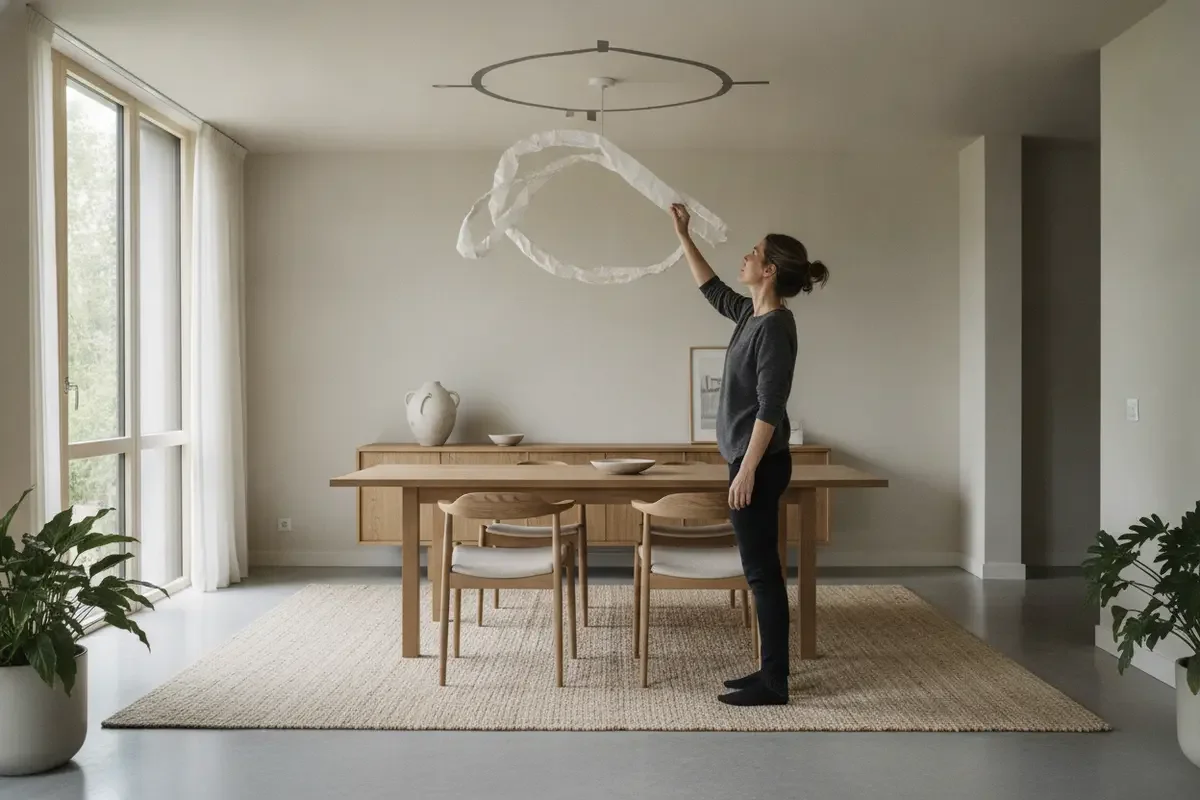
Paper outline taped below a ceiling to test a sculptural fixture’s size from several room viewpoints
Choose a sculptural ceiling fixture by balancing its visual presence with the room’s scale, sightlines, shadow patterns and other sources of light. Test its outline in place, consider how it looks from where you actually sit and walk, and let one clear focal point lead. With those checks, the ceiling can become part of the room’s design without asking every other detail to compete.
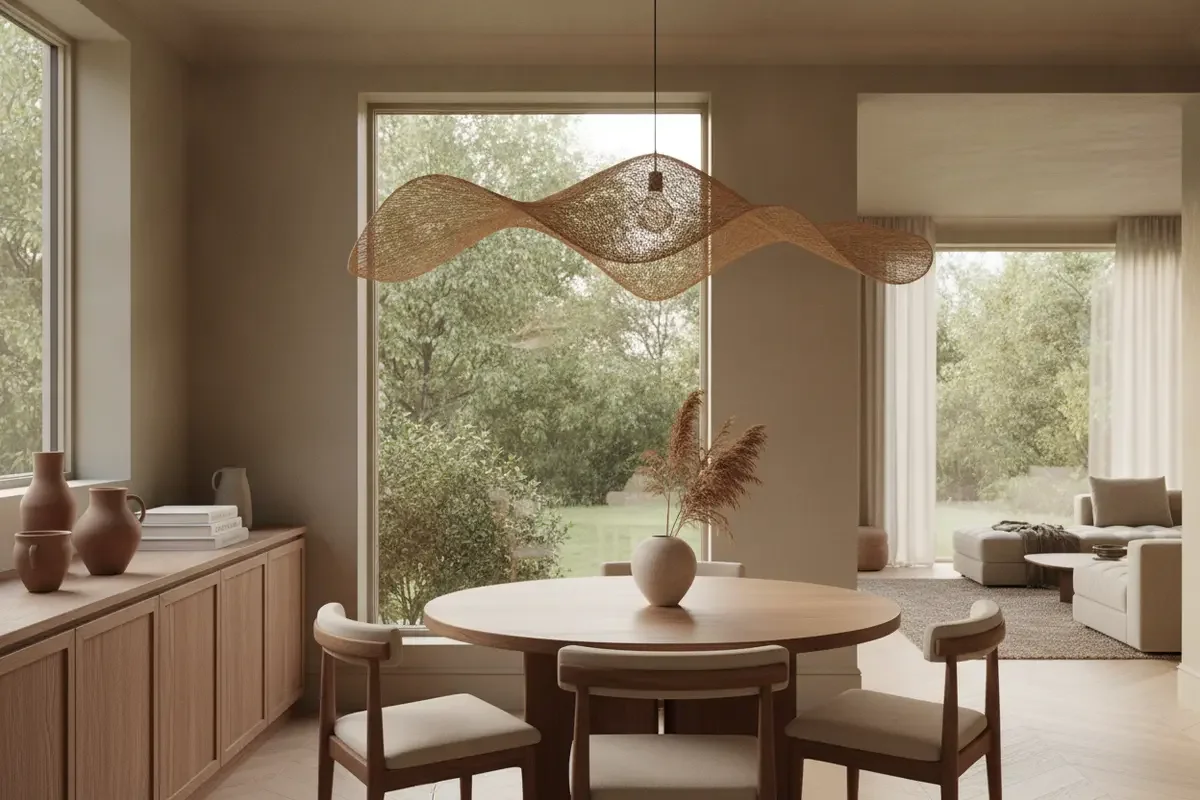
Sculptural ceiling pendant considered alongside a dining table, open sightlines and quieter decor
