

Art Deco Ceiling Light: A Layered Lighting Guide
An art deco ceiling light can give a room a clear focal point before you add a single decorative object. The trick is choosing a fixture that respects ceiling height, room proportions and how the space is used, then balancing its overhead glow with light closer to eye level.
Contact us to explore sculptural lighting
What makes an Art Deco ceiling light work in a room?
Art Deco is often associated with geometry, symmetry, repeated lines and polished contrast. Those cues can read as glamorous, but they do not require a room to become a period set. A ceiling fixture can carry the mood through a stepped silhouette, a fan or sunburst motif, a globe arrangement, or a crisp relationship between metal and glass.
Think of the fixture as a composition viewed from below and from across the room. Its outline matters when it is switched off; its direction and distribution of light matter when it is on. A sculptural shape may look striking in a product photo but feel crowded if its arms, shades or ornament compete with a low ceiling, beams, or a busy ceiling medallion.
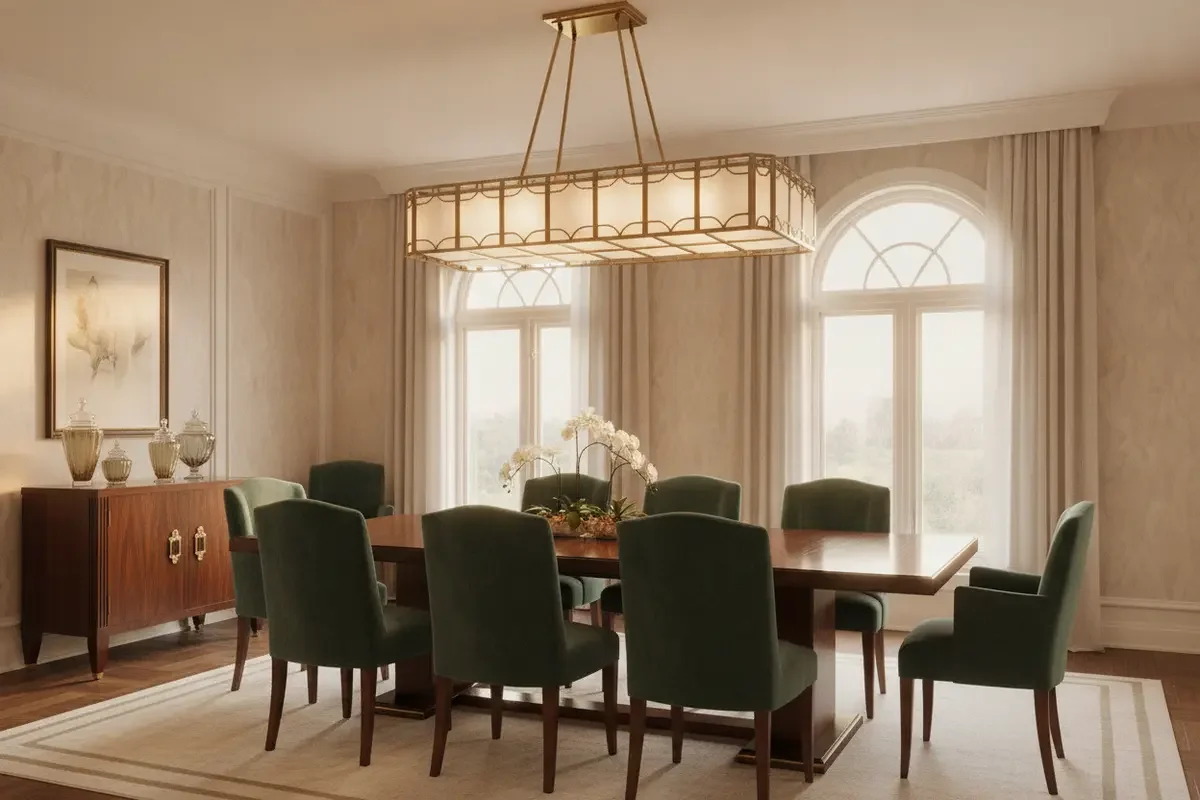
Geometric Art Deco-inspired ceiling light scaled to a dining table and room height
There are real historical examples of the form. The Smithsonian's National Museum of American History collection includes an Art Deco ceiling fixture. Use that as a reminder that ceiling lighting belongs to the period's design vocabulary, not as a template every modern room must copy.
Before shopping, note what you want the fixture to do. Is it the room's central visual anchor, a pool of light over a table, or a decorative layer supplementing recessed or wall lighting? A clear job makes the style easier to edit. It also prevents the familiar mistake of choosing by silhouette alone and discovering later that the fixture dominates the room or leaves the corners dim.
How should you size an Art Deco ceiling light?
Scale is the first practical decision. Consider the room's footprint, ceiling height, furniture below the fixture and the visual weight of the design. A broad, open geometric frame can feel lighter than a densely detailed fixture of similar width. Opaque or closely grouped shades can look more substantial than clear elements. These differences matter as much as the stated diameter.
As a starting point, measure the room and the area the fixture needs to serve. In a dining space, relate its footprint to the table rather than to the entire room. In a living room, consider the main seating zone and how the ceiling fixture relates to a rug, coffee table or other central anchor. These are design checks, not universal sizing rules; the right choice depends on the fixture's profile and the room around it.
Small or visually busy room: Look for a clear outline and restrained depth. A compact geometric or globe form can suggest the era without adding another heavy layer.
Wide room: A larger fixture, multiple coordinated points or a more expansive silhouette may feel more at home than a tiny fitting stranded in the center.
High ceiling: A fixture with enough visual presence can connect the ceiling to the room below. Check the full drop and how it reads from entry points.
Low ceiling: Favor a close-to-ceiling profile when headroom is important. A dramatic hanging fixture can be beautiful, but only if clearance and circulation remain comfortable.
Use painter's tape or a paper template to test the proposed width on the ceiling. Then view it from the doorway and the main seating or dining position. The test will not reproduce the fixture's material or light, but it can reveal whether the footprint feels too small, too broad or off-center.
Which mounting style suits your ceiling height?
Mounting affects both proportion and everyday use. A flush or semi-flush fixture keeps the visual mass close to the ceiling. A pendant or chandelier introduces a longer vertical line and can make a tall room feel more connected to its furniture. Neither is automatically more authentic or more stylish. Choose for the room's geometry and the fixture's purpose.
Mounting approachOften suitsVisual effectCheck before choosingFlush mountLower ceilings or circulation areasCompact, close-to-ceiling profileWhether the form still has enough detail and presence for the roomSemi-flush mountRooms needing a little vertical emphasis without a long dropA modest gap can create shadow and dimensionOverall depth, nearby doors, beams and sightlinesPendantA defined zone such as a table or seating areaDraws the eye down and helps mark a destinationClearance, the fixture's drop, and the path people use around itChandelier-style fixtureRooms with enough ceiling height and visual breathing roomStrong focal point with a more expressive silhouetteScale from multiple viewpoints and whether other statement features compete
Pay attention to the complete installed profile, not just the shade or body. Canopy size, stem or chain, and the fixture's widest points all influence how it sits. If you are replacing an existing fitting, compare the mounting point and the new fixture's coverage. A decorative canopy may not conceal the same area as the old one.
Installation is also a practical constraint, not a styling afterthought. Confirm the ceiling can support the fixture and that the electrical connection and mounting method are appropriate. When the installation involves wiring, structural questions or uncertainty, consult a qualified electrician rather than improvising. Check the manufacturer's instructions and local requirements before purchase.
How do you choose shape, finish and glass?
Start with one or two visual cues instead of collecting every Deco reference at once. Repetition, stepped edges, radial forms, symmetry and rounded globes can each suggest the style. Pick a lead motif that relates to the room. A fan-shaped fitting might echo a patterned screen; a globe arrangement might soften a room built from straight lines.
Next, consider contrast. Brass-toned or dark metal can outline a fixture against a pale ceiling, while a lighter finish may feel quieter. Glass changes the reading, too: clear elements reveal more of the structure, opal or frosted surfaces soften the appearance, and colored glass can introduce a noticeable accent. These are visual tendencies; actual brightness and glare depend on the product's construction and light source.
Make a small palette before deciding. Note the room's dominant metal finishes, wood tones, wall color and any repeated shapes. The ceiling light does not have to match every finish exactly. It can be the deliberate contrast. But if the room already has ornate molding, a patterned floor and several strong silhouettes, a simpler fixture may create better rhythm than another elaborate centerpiece.
For a contemporary interior, use a disciplined mix: one clear Art Deco reference overhead, then simpler supporting forms elsewhere. For a more layered room, repeat a color, curve or metal detail in a second object. Repetition makes the reference feel considered; copying every motif can make it feel like a theme.
How can you layer ceiling light with lower-level fixtures?
An overhead fixture should not be asked to solve every lighting need in a room. It can establish the broad atmosphere or mark a central zone, while table and floor lamps bring light closer to people and create smaller areas of focus. This layered approach also lets you enjoy the ceiling fixture as a sculptural object without relying on it as the only source of illumination.
Define the overhead role. Decide whether the ceiling fixture is the general room layer or mainly a decorative focal point. Keep the expectation realistic for its shape, shade and output.
Add a task layer where needed. Reading, working or other close-up activities may call for a separate lamp positioned for that use.
Bring in a lower ambient layer. A table lamp on a side surface or a floor lamp beside a seating area can soften the transition from ceiling to furniture.
Check the room after dark. Switch on each layer separately, then together. Look for harsh contrast, dark corners, glare and competing focal points.
For instance, a geometric ceiling light centered over a dining table can define the room's main gathering place. A small table lamp on a sideboard can make the far edge of the room feel welcoming when the overhead light is off. In a living room, a more dramatic overhead fitting may be balanced by a quieter floor lamp near the seating. The goal is not to match every shape. It is to make each light feel as if it belongs to the same room.
When you want playful form at a lower level, compare the silhouette and finish with the ceiling choice. Mr. John's Goods' Woaw Lighting Collection offers sculptural table and floor lighting rather than ceiling fixtures. Its steel bodies, ceramic shades and integrated LEDs can provide a different scale of statement below the ceiling. Browse the table lamp range or floor lamp range to consider how a lower layer might relate to your overhead choice.
What should you check before buying?
A few careful checks can prevent a beautiful fixture from becoming an awkward fit. Make a short list and compare actual product specifications, not only styled photographs.
Measure the room and mounting area. Record ceiling height, fixture width and full drop. Include furniture and walking paths below it.
Confirm the light source and controls. Review whether the fixture uses an integrated light source or replaceable bulbs, and check compatibility with any dimmer or control you plan to use. Do not assume features that are not listed.
Understand light direction. Look for product details showing whether light is directed down, outward or upward. A beautiful form can distribute light differently from what a room needs.
Review installation requirements. Confirm the mounting and electrical details with the seller or a qualified electrician if anything is unclear.
Assess the room as a whole. Note existing ceiling details and other focal points. A chandelier, large artwork and bold wallpaper may all compete for attention.
Check delivery and return terms. Review the retailer's policies and lead times before ordering, especially for made-to-order pieces.
It can help to shortlist three options rather than dozens. Compare a close-to-ceiling form, a modest drop and a more expressive silhouette. Then test each against the same room measurements and mood. This is more useful than comparing unrelated fixtures by finish alone.
For a complementary lower-level design, explore the Woaw Triple Floor Lamp as one sculptural example. The collection is made to order; the pre-order information explains the ordering destination and process. A ceiling fixture and a floor lamp do not need to be a matching set. A shared color, curve or sense of playful geometry is often enough.
Contact us to find a sculptural lower-level light
Frequently Asked Questions
Can an Art Deco ceiling light work in a modern room?
Yes. Choose a clear geometric or symmetrical reference and keep the surrounding decor edited. Repeating one finish, curve or color elsewhere can connect the fixture to the room without turning the whole space into a period set.
Is a flush mount or pendant better for a low ceiling?
A flush or semi-flush profile is often a practical place to start when headroom is limited. Compare the installed depth and check circulation below the fixture. The best option depends on the actual ceiling, room use and product dimensions.
Should the ceiling light match table and floor lamps?
Not exactly. Coordinating one or two details, such as finish, color or shape, can make the layers feel related. Different silhouettes can keep the room from looking like a matching set.
Can one ceiling fixture light an entire room?
It may provide a broad overhead layer, but a single fixture will not necessarily meet every task or create the softer atmosphere you want. Add table or floor lighting where people read, gather or need a more localized pool of light.
Make the ceiling part of the composition
A thoughtful Art Deco ceiling light begins with proportion, not ornament. Choose a mounting style that fits the ceiling, edit the shapes and finishes around it, and use lower-level lamps to complete the room. When every layer has a purpose, the ceiling becomes part of the design rather than a detail left until last.
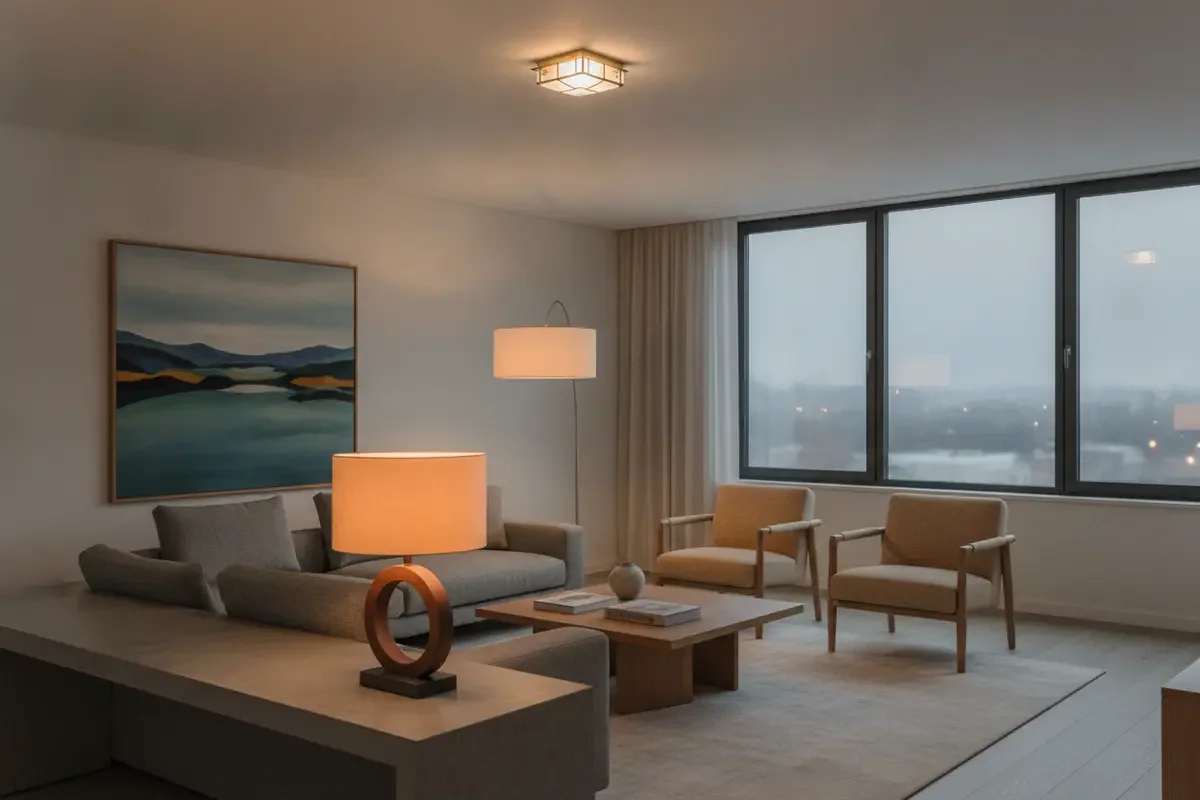
Art Deco ceiling light layered with table and floor lamps in a modern living room
