How a Dining Room Floor Lamp Outperforms a Pendant
A dining room does not need a pendant to feel finished. In a rental or compact apartment, a well-placed floor lamp can bring the table into focus. Add atmosphere, and move with you when the layout, lease, or address changes. No ceiling wiring, drilling, or landlord negotiation required.
Pre-Order a sculptural lamp for your dining space.
Yes, a dining room floor lamp can replace a pendant when its height, reach, and shade direct enough light across the table. An arch or adjustable design can create pendant-like illumination from the floor, while a sculptural silhouette gives the room a strong visual anchor even when switched off.
The best choice depends on more than brightness. You also need to consider how easily the lamp can adapt to a rental. How it supports meals and conversation, and whether it complements the scale of your table. For a broader room-by-room approach, see our Room-by-Room Lamp Styling Guide, then start with the practical advantages that make floor lamps especially appealing in apartment dining areas.
Why Renters and Apartment Dwellers Reach for Floor Lamps Over Pendants
A pendant can make a dining table look instantly considered, but it also asks for a very permanent relationship with the ceiling. For renters and apartment dwellers, that may mean landlord permission, an electrician, ceiling drilling, and a fixture that has to stay behind when the lease ends. A dining room floor lamp offers the atmosphere without the renovation paperwork. Plug it in, position it beside the table, and let the room have its moment.
No landlord-permitted wiring required
The biggest advantage is wonderfully unglamorous: no installation. A standing lamp supports itself, so it can brighten a dining area without new ceiling wiring or drilling above the table. That matters in older apartments, rentals with strict alteration rules, and homes where the existing ceiling fixture is awkwardly placed. Instead of designing the dining layout around one electrical point, you can place the light where dinner actually happens.
An arch or extended-arm design can send illumination over the tabletop while keeping the base safely to one side. It creates some of the visual effect of an overhead pendant, but the structure stays on the floor. The result is practical, flexible, and far less likely to produce an email beginning with "per our lease agreement."
Portable style that moves with you
A permanent pendant belongs to one room. A floor lamp belongs to your life. When the dining table moves, the layout changes, or you move to a new apartment, a standing lamp can move with it. Its portability is one of the clearest reasons renters choose it over a fixed fixture, especially when frequent relocations make every purchase earn its packing space.
That flexibility does not have to look temporary. Choose a silhouette with enough presence to anchor the table, then treat it as furniture rather than an emergency light source. A sculptural body can define the dining corner by day and cast a welcoming pool of light by evening. In an open-plan apartment, that visual anchor also helps separate the dining zone from the kitchen or living area without adding a wall.
Big design energy, small commitment
The best rental-friendly lighting does more than solve a wiring problem. It gives the room personality. Look for a stable base, a scale that complements the table, and a shade or arm that directs light where you need it. A bold finish can bring the playful contrast of a pendant while preserving the freedom to rearrange later.
For a statement piece made to travel from one dining setup to the next, browse the Woaw floor lamp. It brings sculptural character to the room without asking your ceiling, landlord, or future floor plan for a lifetime commitment.
How a Dining Room Floor Lamp Lights a Table Effectively
A floor lamp can do more than brighten an empty corner. With the right shape and placement, it can send useful light across the table. Create a warmer atmosphere, and give the dining area the visual focus usually provided by a pendant. The trick is to treat the lamp as part of a layered plan rather than expecting one fixture to do every job.
Lighting design guidance commonly divides a well-lit room into ambient, task, and accent layers. Ambient light fills the room, task light supports a specific activity, and accent light adds emphasis or mood, as GE Lighting explains when it walks through how the layers work together. Dining belongs firmly in the task-lighting conversation: people need enough visibility to eat, host. Read a menu, or linger over a game without staring into a harsh, exposed bulb.
Choose a shape that reaches over the table
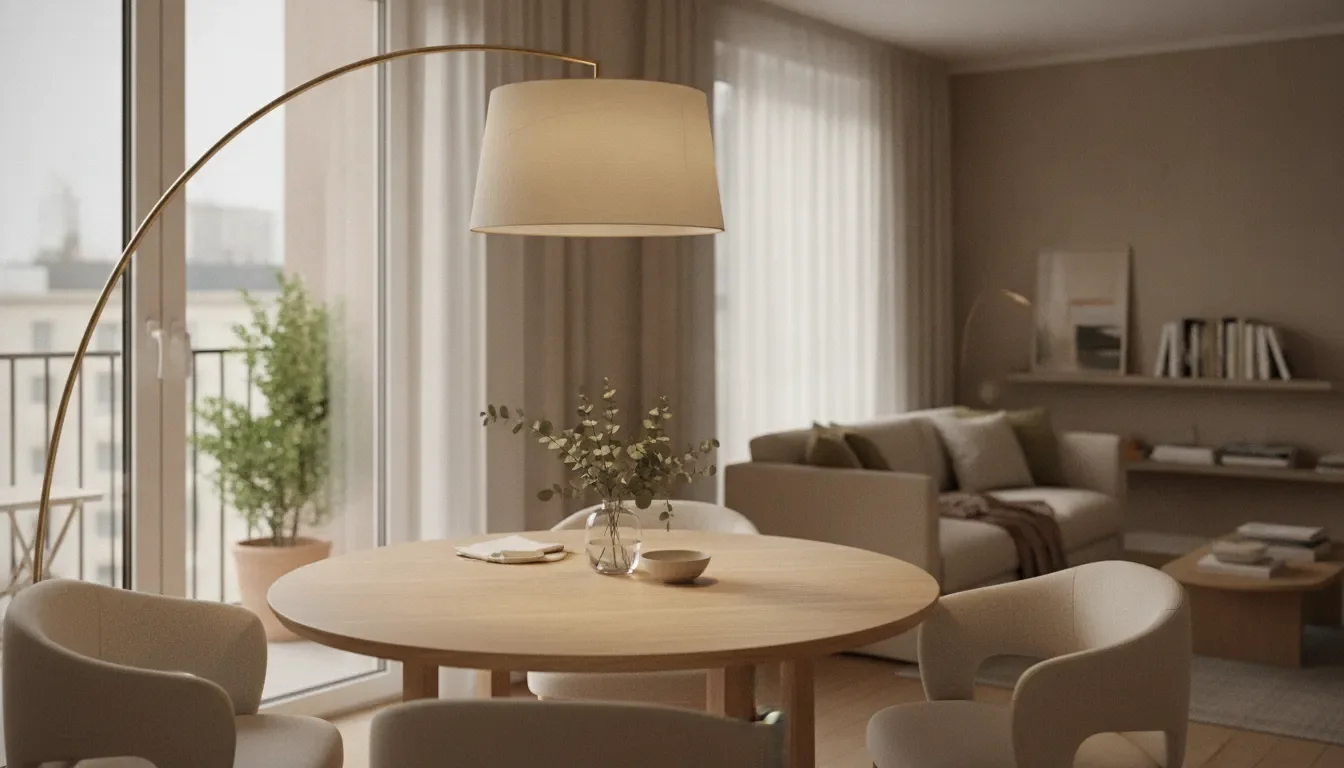
An arch floor lamp is especially useful because its arm can extend from the edge of the dining area toward the center of the table. The shade sits above the eating surface, creating a pendant-like pool of light without ceiling wiring. Adjustable designs offer a similar advantage. Their heads can be angled toward the table instead of sending most of the illumination into a wall or across the room. Arch floor lamps are widely recognized as a practical way to create overhead-style light without installing a ceiling fixture. While adjustable floor lamps can direct focused illumination where it is needed. Explore arch and adjustable floor lamp designs when comparing silhouettes for your room.
Let the shade soften the useful light
Direction matters, but diffusion matters too. A directed shade helps aim the beam across the tabletop, while a ceramic shade can soften the glow so the result feels inviting rather than clinical. This balance is valuable in a dining room, where the light should reveal food, faces, and table settings without producing hard glare in someone's eyes. A warm LED source can carry that effect into the evening, giving the table a relaxed glow while the room's ambient layer handles the surrounding space.
Integrated LEDs make the setup especially clean. Instead of adding a visible bulb and separate fixture hardware, the light source is built into the lamp's design. A sculptural steel body with a ceramic shade can therefore act as both lighting equipment and a considered dining-room object. Place the base just outside the main path of chairs, angle the shade toward the table's center, and use other low-level light nearby to prevent stark contrast. The result is functional table illumination with the personality of a statement piece, and no hardwiring required.
The Placement Rules for a Dining Area Floor Lamp
A dining room floor lamp works best when it feels intentional rather than parked beside the nearest outlet. Start by treating the table as the center of the lighting plan. Place the lamp beside, or slightly behind, one corner of the table so its shade can reach over the surface without competing with plates. Serving dishes, or the person seated at the end.
Height is the first practical test. The lamp should be tall enough for its light to spread across the tabletop, not stop at the edge like a spotlight with stage fright. An arched or adjustable design gives you more control because you can aim the shade toward the center of the table while keeping the base at the perimeter. Floor lamps are commonly used in settings ranging from corner reading areas to center-of-room dining spaces. But the correct height still depends on the table, shade, and room proportions. See examples of floor lamp shapes and placements before choosing a silhouette.
Keep the base out of the dining choreography
Dining rooms have more traffic than they appear to. People pull chairs back, carry hot dishes, move between the table and kitchen, and occasionally perform the classic one-handed plate-balancing routine. Keep the lamp base outside the main circulation path, ideally beside a table corner or just beyond the chair line. Avoid placing it where a chair leg, open door, or walkway can catch it.
A stable, heavy base matters in this location. Stability is especially important for lamps in busy, high-traffic areas, so prioritize a footprint that feels planted rather than delicate. If the lamp sits on a rug, check that the rug does not create a rocking point beneath the base. Run the cord along the wall or furniture edge, secure it neatly, and never allow it to cross the route people use to reach their seats.
Use the lamp to frame the table
Scale is visual as well as functional. A very slim lamp beside a substantial dining table can look lost, while an oversized base may make the corner feel cramped. Balance the lamp's visual weight with the table and nearby furniture. A sculptural design can hold its own beside a broad wood table. But it should still leave enough breathing room for the room to feel easy to move through.
In an open-plan apartment, placement can do more than illuminate dinner. Positioning a floor lamp near the table helps signal where the dining zone begins and ends. Giving the eating area a visual boundary without a wall or permanent fixture. For a deeper look at using a lamp as a visual anchor, explore this floor lamp placement guide. The same principle applies at the dining table: light defines the moment, furniture defines the function, and the lamp quietly connects the two.
Floor Lamp vs. Pendant: Which One Wins for Your Dining Room?
The better choice depends on whether your dining room needs a permanent focal point or flexible lighting that can move with the way you live. A pendant delivers clean overhead light, especially across a large table. But a floor lamp can create a similarly intentional pool of light without opening the ceiling or committing the room to one layout.
Dining room floor lamp and pendant comparison
Criterion Floor lamp Pendant
Installation Plug in and position it. No ceiling wiring or hardwiring is required. Usually requires a hardwired ceiling connection and, in some homes, professional installation.
Mobility Easy to reposition when you rotate the table, change the layout, or move homes. Stays fixed over its original location unless the fixture is rewired.
Light control An adjustable or arched design can direct light toward the tabletop. Dimmable controls can add flexibility. Provides consistent overhead illumination, often with a strong central focus over the table.
Visual impact Can act as a sculptural centerpiece and add architectural interest even when switched off. Creates a classic visual anchor above the table and can feel especially polished in a larger dining room.
Renter-friendliness Highly renter-friendly because it works with an existing outlet and can travel to the next apartment. Less renter-friendly when installation would alter the ceiling or require landlord approval.
Cost Often a more accessible update because it avoids installation costs and can serve another room later. The fixture price may be only part of the investment once wiring, installation, and ceiling work are included.
When does a pendant make more sense?
Choose a pendant when the table has a fixed position and you want the most direct overhead effect. A well-scaled pendant can distribute light cleanly across a long dining table, visually center the room, and keep the floor perimeter clear. It is also a strong option when the ceiling already has a suitable electrical point, so installation is straightforward.
Why does the floor lamp win for flexible dining rooms?
For renters, apartment dwellers, and open-plan homes, the floor lamp usually earns the practical victory. Arch floor lamps are particularly useful because they can reach over a table and provide overhead-style light without ceiling wiring. Floor lamps can also help define the dining zone within a larger room, while their portability makes them easier to reuse after a move or layout change.
The design decision still needs discipline. A tall lamp with too much visual weight can overwhelm a compact table, so select a silhouette and base that balance the furniture rather than competing with it. A stable base matters in a busy dining area, too. If your table is large and permanently placed, a pendant may be the cleaner answer. If your dining room needs personality, flexibility, or a lighting upgrade without construction, a thoughtfully placed Woaw floor lamp is the more adaptable win.
When a Sculptural Floor Lamp Beats a Pendant as a Visual Anchor
A pendant usually claims attention from above. A sculptural floor lamp can create the same sense of occasion from the edge of the room. While giving your dining area a more flexible and furniture-aware focal point. That distinction matters in an open-plan apartment, where the best lighting choice needs to do more than illuminate the table.
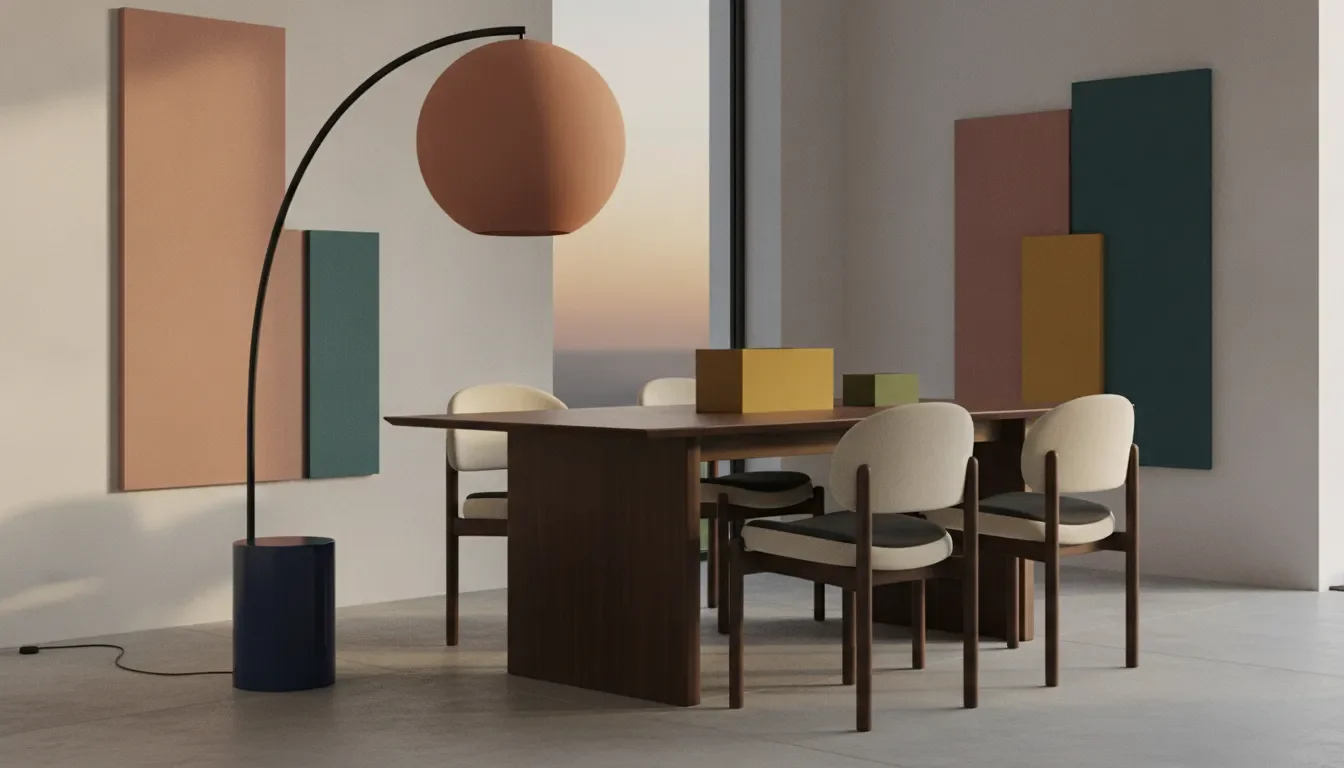
Think of the lamp as part of the architecture, not an object you switch on and forget. A tall, expressive silhouette can draw the eye toward the dining zone, frame the table, and add visual interest even when the light is off. That is especially useful when your ceiling is low, your rental rules prohibit rewiring. Or your dining table sits in a space that was never designed for a pendant. As a starting point for balancing furniture, light, and circulation, see the Room-by-Room Lamp Styling Guide.
Let the form do some of the decorating
A pendant tends to be judged by its shade and the way it hangs above the table. A floor lamp has a longer visual conversation with the room: base, stem, shade, and negative space all contribute to the composition. Look for a shape that echoes something already present, such as the curve of a chair back. The vertical line of a cabinet, or the rounded edge of the table. The result feels intentional without requiring a matching lighting set.
There is no single correct look. Modern, traditional, and arch floor lamps cover a wide range of interior aesthetics, so a minimalist dining room can take a quiet. Linear design while a more expressive space can handle stronger color or an unexpected silhouette. The useful test is scale. The lamp should be noticeable from the entry to the room, but its visual weight should still balance the table and surrounding furniture rather than overwhelm them. IKEA's floor-lamp guidance similarly emphasizes choosing pieces that suit the scale of the space and furniture (IKEA).
Use light to change the dining mood
The same sculptural lamp can support several versions of dinner. A brighter setting helps the table feel active and practical for meals, games, or homework. A softer setting makes the area feel more intimate when the plates are cleared and conversation takes over. Lighting can change a room's mood from cozy to invigorating, according to the Mayo Clinic, while color temperature also influences whether a space feels relaxing or alert.
Position the lamp so its glow reinforces the dining zone rather than competing with it. In an open-plan layout, that pool of light can visually separate dinner from the kitchen or lounge without adding a wall. The lamp becomes a quiet boundary: a sculptural marker by day and a warm gathering point by night. For more ideas on using bold floor lighting as decor, explore statement floor lights, then adapt the principle to your dining room's proportions and pace.
How the Woaw Steel-and-Ceramic Floor Lamps Handle the Dining Room Scale
A dining room needs lighting with enough presence to hold its own beside a table and chairs. Woaw floor lamps meet that scale through sculptural form rather than installation drama. Their steel bodies create a confident vertical silhouette, while ceramic shades add a tactile, considered finish that feels closer to gallery design than ordinary utility lighting.
That makes the collection especially useful when a pendant is not practical. Renters and apartment dwellers can bring a strong focal point into the dining area without drilling into a ceiling. Rewiring a junction box, or asking a landlord for permission to make the room feel finished. A floor lamp can stand beside the table, define the dining zone, and contribute to the room's atmosphere while remaining easy to move when the layout changes.
Why the materials matter at dining-room scale
Steel gives the lamps a clean architectural backbone. It helps the silhouette read from across an open-plan room instead of disappearing behind the table. The ceramic shades soften that structure with color, shape, and visual warmth, so the result does not feel like a bare task light parked beside a chair. Together, the materials create balance: enough structure for a larger room, enough personality for a home that is not interested in bland background lighting.
Each lamp uses an integrated LED, keeping the design visually streamlined without a visible bulb competing with the shade. LEDs are also an energy-efficient lighting choice, which suits a fixture intended to become part of the room's everyday rhythm, as the Department of Energy's LED basics guide explains. Use the lamp as a welcoming layer during dinner, a gentle glow after the dishes are cleared, or a sculptural accent when the main lights are off. It can do more than one job without looking like it was designed for none.
Choosing a Woaw floor lamp for the room
The Woaw range includes the Woaw floor lamp, along with the triple-floor and double-tilt-floor forms. That range gives the dining room different kinds of visual energy. A single vertical form can create a crisp punctuation mark beside a compact table. A multi-arm silhouette can carry more presence in a generous dining area or open-plan layout. The double-tilt-floor design adds directional character, helping the composition feel intentional rather than simply placed near an outlet.
All three options are built for international flexibility, with universal 120V-240V compatibility and US, UK, and EU plug options. They are made to order, so pre-orders ship within two months rather than arriving as an immediate off-the-shelf purchase. That lead time is part of the considered-design experience: you are choosing a distinctive piece made to bring gallery-quality personality into the room. Not grabbing another anonymous lamp on the way home.
For a dining room that needs impact without permanent construction, this is the sweet spot: a substantial vertical statement, integrated light, and no ceiling project required. Simple setup, big vibes.
Pre-Order a Woaw floor lamp and give your dining room its sculptural centerpiece.
Frequently Asked Questions
Can you use a floor lamp in a dining room?
Yes. A floor lamp can provide useful light beside or over a dining table without ceiling wiring, making it a practical choice for renters and apartment dwellers. Choose a position that keeps the base and cord outside the main walking path, then angle the light toward the table rather than directly into diners' eyes.
How do you light a dining room without a pendant light?
Build a simple lighting layer with a floor lamp for focused table light, plus ambient or accent sources elsewhere in the room. GE Lighting describes ambient, task, and accent lighting as complementary layers for a well-lit space: GE Lighting. In an open-plan apartment, the floor lamp can also visually mark the dining zone.
What is the best type of floor lamp for a dining room?
An arc or adjustable floor lamp is often the most useful starting point because its arm can direct light across the tabletop while the base stays near a wall or corner. This creates some of the visual effect of a pendant without making a permanent change. Select a shade and silhouette that balance the scale of your table instead of overwhelming it.
How tall should a dining room floor lamp be?
It should be tall enough to spread light across the table surface while keeping the bulb or shade out of the usual sightline. There is no universal measurement because table height, ceiling height, lamp reach, and seating layout vary. Test the lamp from seated eye level, and prioritize a stable base in high-traffic areas.
Ready to Make Your Dining Room Glow?
A floor lamp can give your dining area a warm focal point without asking your ceiling, landlord, or layout to cooperate. When you have found the shape and scale that suit your space, take the next step and bring that sculptural light home. Pre-order the Woaw floor lamp of your choice for a dining room setup that feels considered, flexible, and distinctly yours.