

Choosing the best contemporary floor lamps 2024 is less about chasing a trend and more about finding a lamp that balances useful light with a shape you want to live with. Compare silhouette, construction, light direction, scale and ordering terms before you decide; a striking lamp still needs to work in the room every day.
Ask about choosing a Woaw floor lamp
What makes a contemporary floor lamp worth considering?
Contemporary does not have to mean cold or anonymous. A floor lamp can bring a clean outline, an unusual proportion or a playful detail into a room while still serving a practical purpose. Start by asking what job the lamp should do: add a pool of light near a seat, contribute to the room’s overall glow, or act as a sculptural focal point.
These roles can overlap, but they are not identical. A lamp chosen mainly for its silhouette may draw the eye even when switched off. One chosen for reading should put light where you need it without forcing you to rearrange the room around the fixture. For ideas on combining sources, see this guide to layering living-room lighting.
Think of “best” as a match between the fixture and your priorities, not a universal ranking. A sculptural design can be a strong choice for someone who wants personality and a visible design object. A simpler, adjustable lamp may be better if the first concern is directing light for a particular task. Consider the room’s routine too: a reading corner, a conversation area and an open living-dining space ask different things of a floor lamp. Write down the main use before browsing, then treat secondary benefits as a bonus rather than letting them blur the decision.
How should you compare the best contemporary floor lamps 2024?
Use a consistent checklist rather than letting a dramatic photograph make the whole decision. The table below separates common priorities and the details worth checking. It is a comparison framework, not a claim that every lamp offers every feature.
What to compare Why it matters What to check
Silhouette and presence Sets the visual character and how strongly the lamp reads as a statement Overall outline, shade arrangement and how it relates to nearby furniture
Materials Affects the look and feel of the finished object Named body and shade materials; avoid assuming a material from a photo
Light and control Determines whether the lamp supports the intended activity Light direction, included light source, switch and any stated dimming details
Room scale Helps the lamp feel intentional rather than crowded or undersized Published dimensions and a measured footprint against the available area
Electrical compatibility Prevents a mismatch with the destination country’s power system Voltage range and the plug option supplied
Ordering and timing Sets expectations about payment and when the item will ship Pre-order terms, production window, shipping and returns information
To make the comparison useful, record the same information for each candidate in a note or spreadsheet. Add a column for confirmed facts and another for open questions. For example, if one listing states the dimensions but says nothing about dimming, mark dimming as unknown; do not interpret silence as a feature. Separate must-haves from preferences. A destination plug and a workable footprint may be essential, while a particular shade arrangement may be negotiable. This simple distinction keeps a compelling product photo from becoming a substitute for a complete comparison.
Which materials and construction details should you inspect?
Look for clear material descriptions rather than relying on styling language. The Woaw Lighting Collection uses steel bodies and ceramic shades. Those are useful facts to compare against other candidates’ stated materials. Ask whether the product page identifies the main components, how the shade is made and what is included with the fixture.
Construction choices shape the appearance as well as the maintenance routine. A ceramic shade has a distinct solid, crafted presence; a steel body can provide a crisp, defined outline. Neither material alone tells you how a lamp will perform, so check the specific product information for light source, care guidance and warranty or returns terms. For a closer look at the material distinction, read the steel and ceramic lamp construction guide.
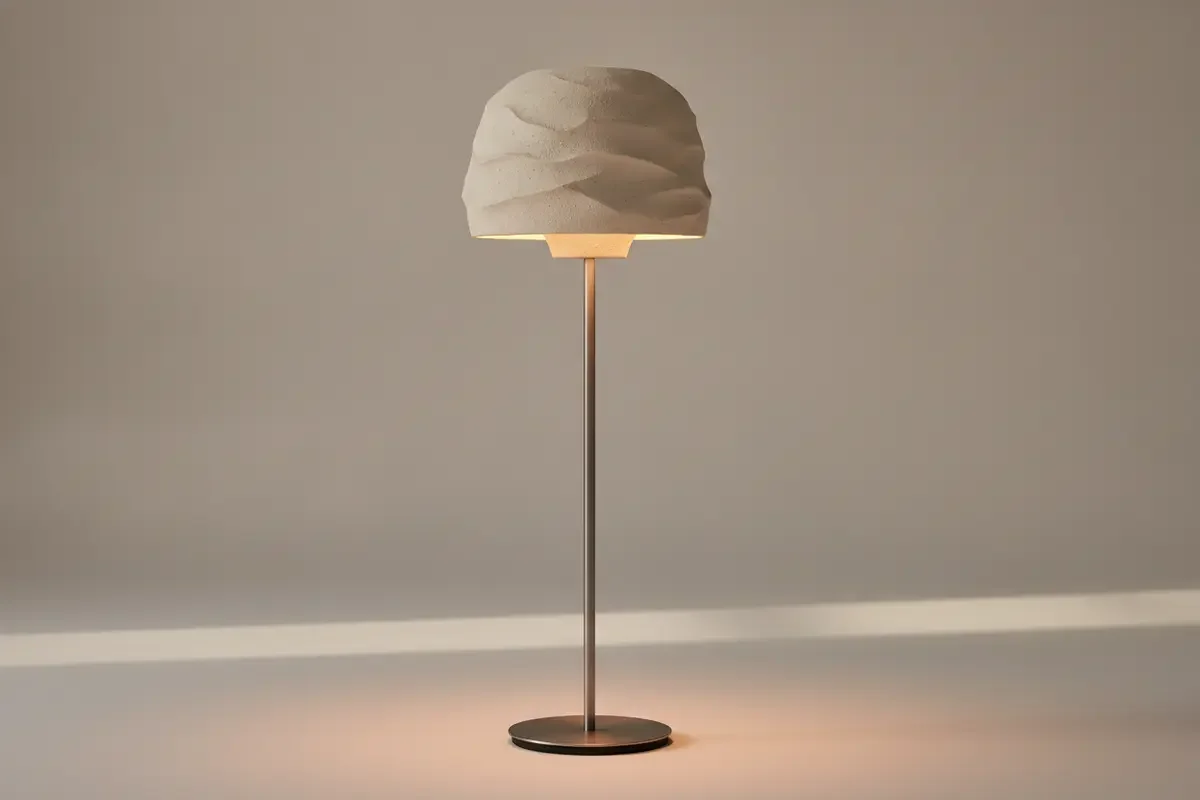
Be cautious with vague claims such as “premium” if the listing does not identify materials or construction. Ask for the practical details that matter to you, and compare them on equal terms. The Woaw collection’s sculptural forms reinterpret traditional candelabra shapes, using bold color blocking for a more playful take on a floor lamp. If you are comparing a steel-and-ceramic design with another lamp, consider what the material description actually tells you: composition, finish and care information are more useful than a broad adjective. Check the maker’s instructions for cleaning and handling, especially for ceramic components, and do not assume all finishes need the same care.
How do proportion and color affect the choice?
Before choosing a shape, measure the area where the lamp will sit and note the height of nearby furniture. Compare those measurements with the published product dimensions. Leave enough room for people to move naturally, and consider whether the shade or arms would visually compete with artwork, shelving or other tall objects.
One useful test is to mark the lamp’s approximate footprint on the floor with removable tape. A paper outline can help you judge the scale before ordering. Look at the space from the doorway as well as from the seat where you expect to use the lamp; a piece that feels balanced close up may look very different from across the room. Include the plug’s path in your planning: a good position is less useful if the cord crosses a route people use or cannot comfortably reach the outlet.
Color can make a lamp blend in or become the room’s punctuation mark. If the room is quiet and neutral, a bold fixture can add energy without requiring a full redesign. If the room already has strong color and pattern, look for a lamp whose palette repeats one existing note rather than adding a competing one. The color-blocking guide offers a simple way to think about relationships between colors.
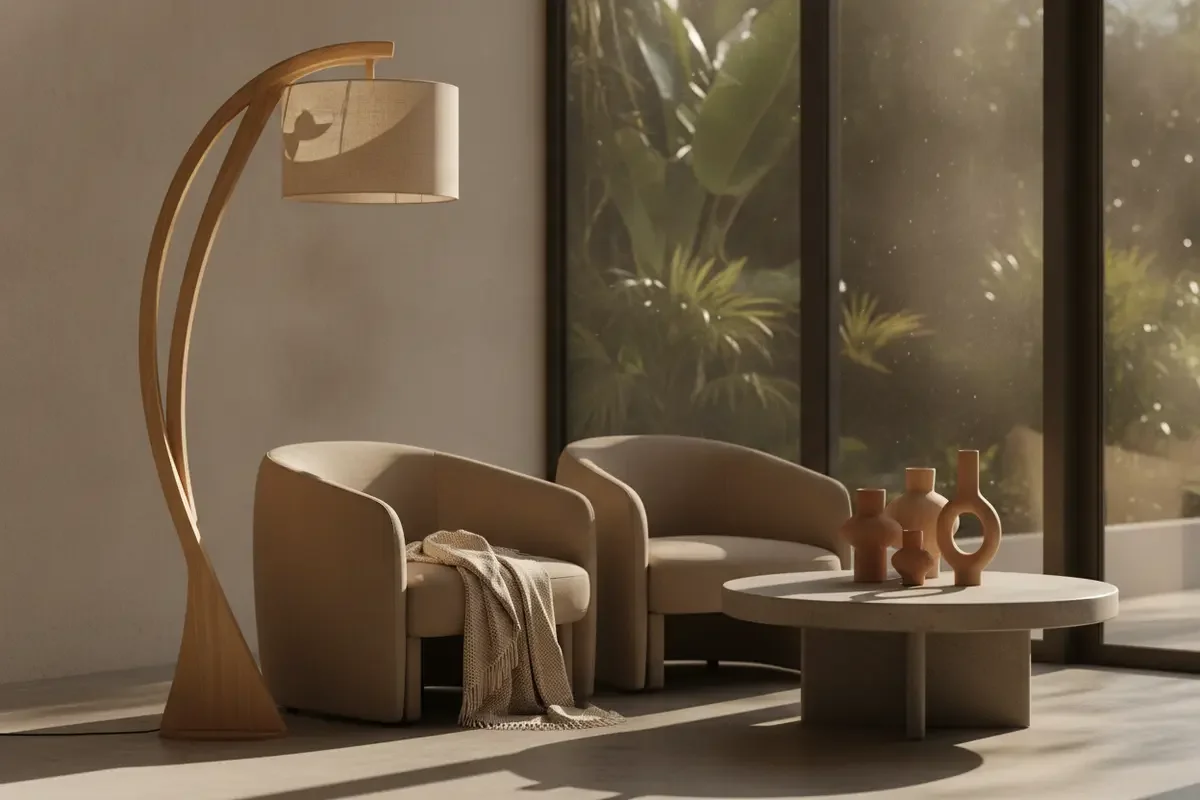
Test color in context rather than judging it against a white product-page background alone. Hold a swatch, book cover or cushion near the proposed spot, then look from the room’s usual viewpoints. A color may appear more vivid against a pale wall and more restrained beside darker furniture. You do not need to match the lamp exactly to another object; repeating a related hue or balancing a strong color with neutral surroundings can be enough. For a bold, toy-inspired shape, decide whether you want a focal point or a quieter visual link before selecting a palette.
What should you know about light and electrical compatibility?
First identify the task. Ambient light should contribute to the room’s general brightness; a reading or work light needs to reach the activity area. Check where the light is directed and whether the listing explains the controls. Do not assume that a sculptural shade sends light in every direction or that a product is dimmable unless the product details say so.
The Woaw fixtures include integrated LEDs. The collection is described as compatible with 120V–240V power and as offering US, UK and EU plugs. Before ordering, confirm that the specific product option and plug are suitable for the destination. Universal voltage does not remove the need to select the right plug configuration.
For general electrical safety, follow the product instructions and local requirements rather than relying on appearance alone. The U.S. Consumer Product Safety Commission’s consumer safety guidance is a starting point for checking product-safety information; always consult the instructions supplied with the specific fixture. The table lamp versus floor lamp comparison can also help you decide whether a floor fixture is the right form for the job.
When comparing lighting descriptions, distinguish a stated feature from an assumption. “Integrated LED” tells you the light source is built into the fixture, but it does not by itself specify brightness, color temperature, replacement procedure or dimming behavior. Look for each detail on the product page or in the instructions. If one matters to your routine—such as a particular switch position or a softer evening setting—confirm it before placing an order. The same applies to voltage: check the range and plug together, and consider the destination socket rather than relying on a general label such as “global.”
How do price and ordering terms fit into the decision?
Compare like with like: design, materials, included lighting, dimensions and delivery terms. A price by itself cannot tell you whether a lamp is a good match. For verified Woaw pricing, the floor-lamp range is $356–$491; table lamps are a separate category, priced at $282–$410. Confirm current product-page pricing before purchasing.
Woaw lamps are made to order, with a 60-day production window and full payment upfront before manufacturing begins. That means the timing is part of the decision. If you need a lamp by a specific date, account for production and shipping time rather than treating a pre-order as an in-stock purchase. The pre-order lamps guide explains the basic points to review.
Read the destination page carefully for the current order process, shipping details and return terms. You can see the Woaw floor lamp options and compare individual designs before taking the pre-order route. For a broader look across styles, browse the Woaw Lighting Collection.
Make a delivery plan instead of treating the production estimate as the full timeline. If you are furnishing a room for a move-in or event, count backward from when you want the lamp in place, then leave room for shipping and any uncertainty in transit. Review payment timing and returns before you commit, particularly if the lamp’s arrival date is important. Keep a copy of the selected product and plug option with your order notes so you can resolve any questions against the same details you used to compare it.
How should you evaluate a lamp in your own room?
A product image can show shape and color, but it cannot settle every question about how a lamp will feel in your space. Make a small room-specific plan before comparing models. Note the intended spot, the nearest power outlet, the walking route and the main viewing angle. This turns “I like the look” into a more useful test: will the fixture fit the circulation, support the activity and add the kind of visual emphasis you want?
Try this sequence:
Measure the available floor area and the height of nearby seating, tables and shelves.
Mark a likely base footprint with tape, then walk past it from the usual entry and seating routes.
Estimate where the light source will sit relative to the person using it; check the published information rather than assuming the beam direction.
Look at the wall and furnishings behind the planned spot. A busy background may make a highly detailed silhouette feel less distinct.
Repeat the check in daylight and after dark, because the lamp’s color and presence can read differently in each condition.
If you are comparing several models, keep the same measurements and questions for each. A quick note beside each candidate—dimensions, light direction, material, plug, price and lead time—makes differences easier to see. It also prevents an appealing photograph from distracting you from a practical mismatch such as a blocked walkway or a long production window.
For a practical example, imagine a compact reading nook beside a sofa. First measure the space between the sofa arm and the walking path; then check whether the lamp’s base can fit without narrowing that route. Next consider the height and position of its light source relative to the seated reader, using product specifications rather than judging from a styled photograph. Finally, confirm that the cord can reach the outlet safely and that the selected plug matches the destination. The same method works in a larger room, but the visual test changes: assess the lamp from farther away and check whether its outline has enough presence to relate to the furniture around it.
How can you balance a statement silhouette with the rest of the room?
A sculptural floor lamp works best when you decide what should have the most visual emphasis. If the lamp is the focal point, let nearby forms be quieter: a simple side table, restrained wall art or a more limited color palette can give the outline room to register. This does not mean the rest of the room must be plain. It means the elements should feel intentional together.
For a subtler effect, repeat one feature of the lamp elsewhere. A color may appear in a cushion, book cover or artwork; a rounded shade can relate to another curved object. Repetition creates a visual connection without requiring a matching set. Avoid copying every color and shape, which can make a room feel overly coordinated.
Think about sightlines as well as the object itself. From a doorway, a tall fixture may overlap with a painting or shelving. From the sofa, the same lamp may frame the seating area. If you are uncertain, take a photo from those viewpoints and compare a taped outline or a temporary stand-in at roughly the intended height. These simple checks help you judge whether the lamp adds a clear accent or competes with existing pieces.
Use the room’s existing visual rhythm as a guide. If most furnishings have straight lines, a curved or multi-part outline can introduce contrast; if the room already contains many sculptural forms, a simpler lamp may provide balance. Consider negative space too: leave enough visual breathing room around an expressive fixture so its shape remains readable. In a layered room, the lamp need not match every object. A deliberate contrast—playful form against restrained surroundings, for instance—often feels more personal than a perfectly coordinated set.
What practical questions should you ask before ordering?
Before committing, confirm details that affect delivery and use, not just the styling. Check the exact product page for the model name, dimensions, materials, included integrated LED information, voltage range and available plug. If any information is missing or unclear, ask the seller before placing the order rather than filling gaps with assumptions.
Then review the purchase terms in one sitting. Confirm the current price, whether the item is made to order, the stated production window, payment timing, shipping destination and return policy. If the lamp is intended for a gift, a move or a room project, work backward from the date it needs to be in place. The stated 60-day production window is not the same as a guaranteed arrival date; account for delivery time too.
Save the product details and order information so you can refer back to the selected plug and model. This is particularly helpful when ordering across regions or when you are comparing multiple fixtures. For support about the order process, use the contact page; for current terms, review the returns information.
A clear pre-order checklist can be as simple as six questions: Is this the right model? Do its dimensions suit the planned position? Are materials and light-source details clear? Is the voltage and plug choice appropriate? Does the production and shipping timeline suit my plans? Have I read the payment and return terms? Resolve the unknowns before checkout. That is more useful than comparing many listings without a record of what has actually been verified.
What is a simple checklist before you choose?
Decide whether the lamp’s main role is ambient light, task support or a sculptural accent.
Measure the available area and compare it with the product’s stated dimensions.
Check body and shade materials, included light source and control information.
Confirm the voltage range and plug option for the destination country.
Review current pricing, production timing, shipping and returns.
Consider the lamp from more than one viewpoint and how its color relates to the room.
A shortlist of two or three candidates makes comparison easier. Write down the essential requirements first, such as dimensions, plug type and delivery window. Then compare the visual qualities that are more personal: silhouette, color and how much presence you want the lamp to have.
Use a final pass to sort your notes into three columns: confirmed, needs clarification and preference. A product with one unknown that matters to your routine deserves a question before purchase; a preference can be weighed against the overall look. This prevents a checklist from becoming a box-ticking exercise. The goal is not to find a fixture with every possible feature, but to understand the trade-offs and choose the one whose design and practical terms make sense for your room.
Shop the Woaw floor lamp collection
Frequently asked questions
Are contemporary floor lamps only for modern interiors?
No. A contemporary fixture can work in a range of interiors when its shape, color and materials connect with something already in the room. Repeating a color or balancing a bold silhouette with simpler surroundings can help it feel considered.
What materials are used in the Woaw floor lamps?
The Woaw Lighting Collection is described as having steel bodies and ceramic shades. Check the individual product details for the exact configuration and included components.
Can I use a Woaw lamp outside the US?
The collection is specified for 120V–240V and offers US, UK and EU plugs. Confirm the plug option for your destination when ordering.
How long does a Woaw pre-order take?
The stated production window is 60 days. Review the ordering page for current shipping information, and allow for production and delivery time when planning.
Should I choose a floor lamp or a table lamp?
Choose based on the space, the available surface area and the kind of light you need. A floor lamp occupies floor space and can make a larger visual statement; a table lamp needs a suitable surface. Compare the actual dimensions and intended use rather than choosing by category alone.
The best choice is the one that brings the right combination of form, useful light and practical timing to your space. Measure first, compare verified details, and let the final silhouette bring a little personality to the room.
