

Artistic Table Lamp Guide for Sculptural Accents
An artistic table lamp can do more than brighten a corner. The right one gives a room a focal point, a little personality and a useful pool of light. To choose well, look beyond the first dramatic silhouette: consider scale, materials, shade, light quality and how the lamp will relate to the objects around it.
Contact us to explore sculptural table lighting
What makes an artistic table lamp feel right?
Artistic does not have to mean impractical or oversized. A successful lamp combines a recognizable point of view with a form that feels considered from more than one angle. Its shape might be unusual, its color might interrupt a quiet palette, or its parts might play together like a small sculpture. But it should still make sense in the room and provide the kind of light you need there.
Start by asking what job the lamp has to do. Is it a visual accent first, or do you need it for reading, working or creating a softer evening atmosphere? Those needs can overlap, but one usually leads. A highly sculptural piece may be the room's conversation starter; a more restrained shape may quietly support a task. Knowing the priority helps you compare lamps for a reason rather than choosing by novelty alone.
Then look at the whole composition. Consider the base, stem, shade and light source as parts of one object. Do their proportions feel balanced? Does the shade finish the silhouette or make it feel top-heavy? Is there a deliberate relationship between curves, angles and color? For a focused look at placing a sculptural lamp beside a favorite chair, see our guide to sculptural table lamps for a reading nook.
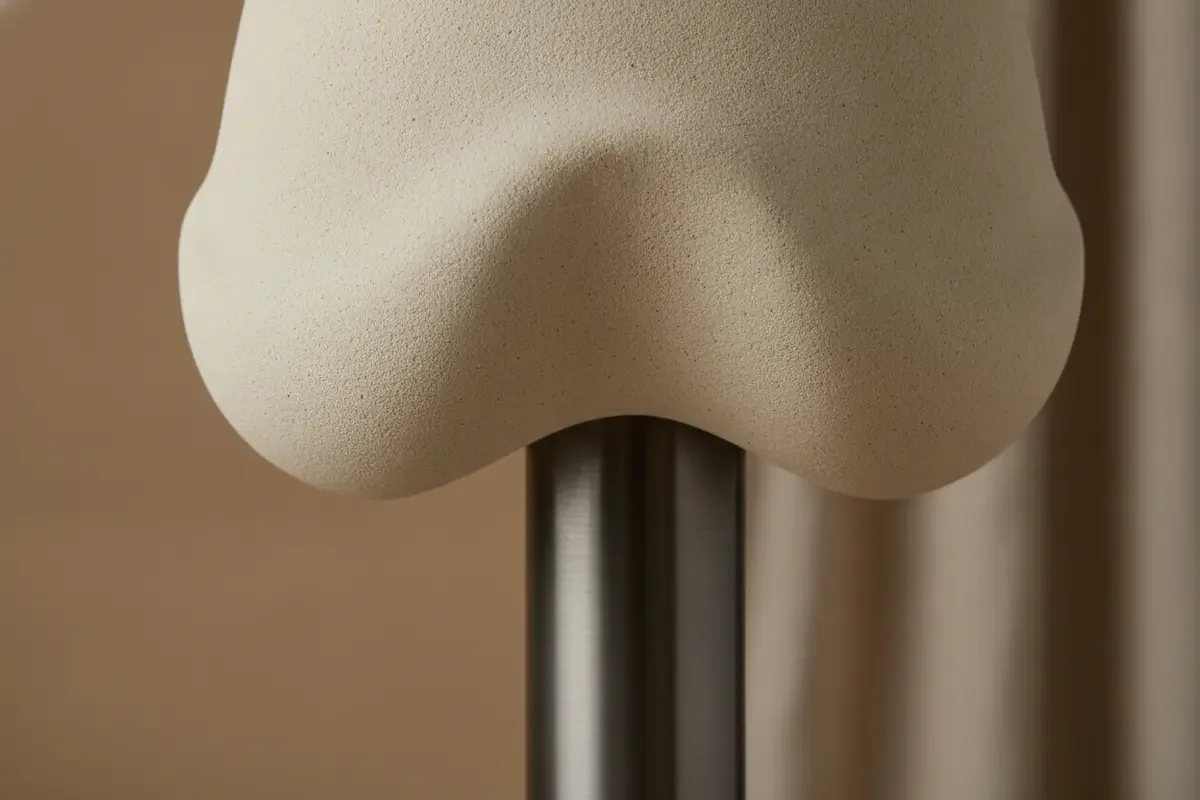
Close view of a sculptural table lamp showing the junction between its shade and steel structure
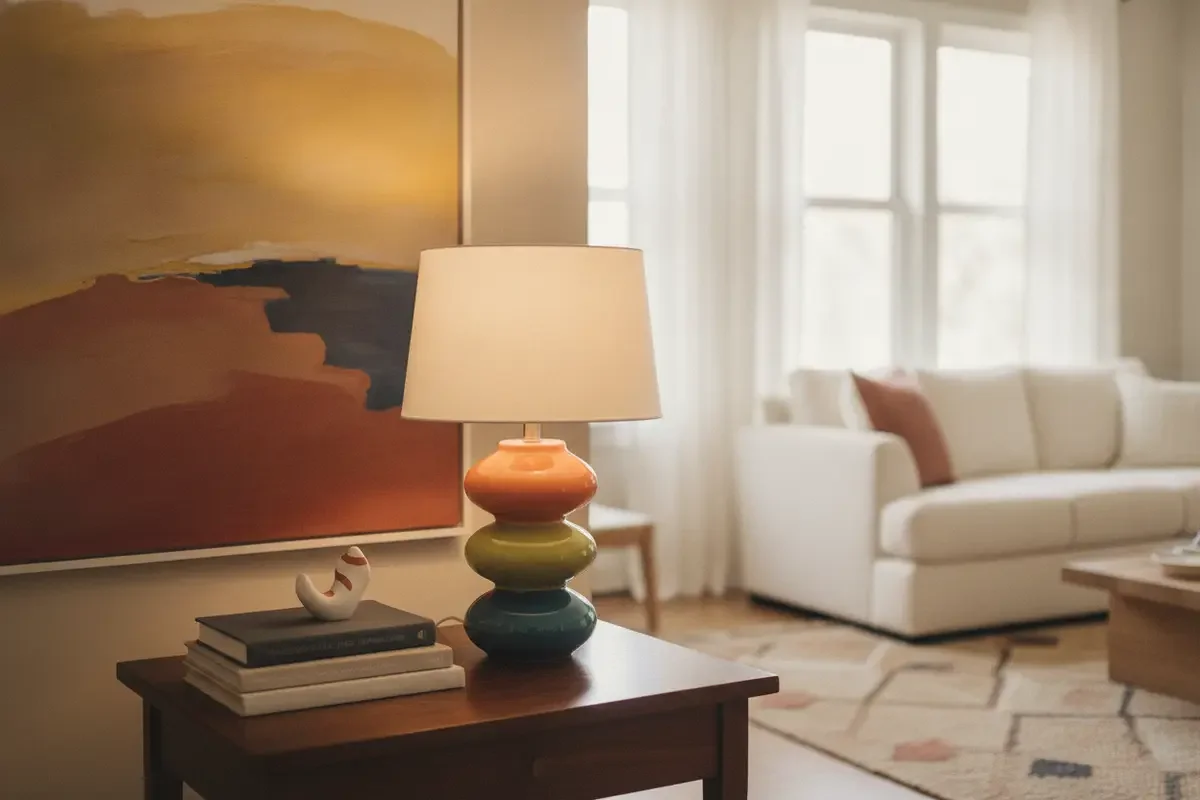
A colorful sculptural table lamp styled with restrained books and art in a contemporary interior
How do you choose an artistic table lamp by silhouette?
Silhouette is often the first thing you notice, and it is what remains legible across a room. Before comparing finishes, trace the lamp's outline with your eyes. Is it tall and narrow, low and wide, symmetrical, or composed of several distinct forms? Picture that outline against the wall and furniture nearby. A clear silhouette can stand out without relying on lots of decoration.
Think about visual weight as well as actual dimensions. A lamp with a broad shade or solid-looking base can feel substantial, even if it is not especially tall. A slender profile may appear lighter, but a cluster of arms, repeated forms or strong colors can also attract attention. Neither is automatically better. The useful question is whether the visual weight complements the objects that share its field of view.
For a calm room: choose a lamp with one strong gesture and a fairly clean outline. Let the shape provide interest instead of layering on several competing details.
For a collected room: a more complex silhouette can join books, art and other expressive objects. Repeat one color or material elsewhere so the lamp feels connected, not random.
For a playful accent: look for confident proportions and a little surprise. Toy-inspired forms can be joyful while still feeling deliberate when their construction and finish are thoughtfully considered.
Try a quick paper test before buying: cut out or sketch a rough outline at the lamp's approximate height and width, then hold it in the intended area. It will not reproduce the finish or depth, but it can show whether the profile would dominate the view or disappear among neighboring shapes. If the lamp will be visible from several parts of the room, consider how the outline reads from each direction.
Which materials and details deserve a closer look?
Materials change how a sculptural lamp looks and how its parts relate. Ceramic can bring a solid, tactile presence to a shade or form. Steel can create a crisp outline and a sense of structure. Glass, wood and other finishes each have their own visual character. Compare the material to your existing surfaces, but also ask whether the material is doing meaningful work in the design.
Look closely at transitions: where a shade meets a stem, where one color ends, or where a base supports an upper form. Clean, intentional joins make a designed object feel coherent. A strong contrast may be part of the point; a mismatch in finish or proportion can instead make a lamp feel assembled from unrelated pieces. For a closer discussion of material choices in the Woaw designs, read about steel and ceramic lamp construction.
Shade material and geometry also shape the overall effect. A shade can frame the light source, direct attention upward or outward, or create a strong block of color in the composition. Do not judge it only in a product photograph. Look for views of the lamp switched on and off, and examine how the shade sits in relation to the rest of the form. If you are comparing shade materials specifically, our guide to ceramic versus glass lamp shades explores the distinction without reducing the decision to a single right answer.
Light quality matters even in a lamp chosen as art. Ask what the lamp is meant to illuminate and whether the shade appears to diffuse or direct its glow. Historical lamp design offers useful reminders that these details matter: the Museum of Fine Arts, Houston, describes Donald Deskey's 1928 table lamp and its diffuser lenses, designed to produce an even, specific quality of light. That example is not a buying rule, but it shows how lighting effects can be part of a lamp's design language, not an afterthought. See the museum's overview of "Electrifying Design: A Century of Lighting".
How do shape and light work together?
A table lamp changes character when it is switched on. In daylight, you may notice its color, material and outline first; in the evening, the glow and the shadows around it may take over. When comparing an artistic table lamp, look at both states if photographs are available. Ask whether the lamp still feels composed when it is off and whether the light source becomes a distracting bright point when it is on.
Consider what the shade does with light, rather than assuming that all shades behave the same way. Its form and material can affect whether light seems softened, directed or concentrated around the source. Think about nearby walls and surfaces, too: their color and finish influence how a pool of light is perceived. Product imagery can give clues, but it cannot fully show the effect in your own room. Read the manufacturer's lighting details and avoid treating a decorative silhouette as proof of a particular task-lighting performance.
There is also a visual relationship between illumination and shape. A crisp outline may make the lamp feel graphic in daylight, while shadows can add a second layer of character after dark. If the lamp is intended to contribute to reading or focused work, prioritize verified light-use information alongside form. If it is mainly an accent, compare how the object itself and its glow contribute to the mood you want.
How large should the lamp look in its setting?
There is no universal height that makes a table lamp proportionate. The right scale depends on the surface, what sits nearby and what you see behind it. Begin by measuring the available surface and noting the height of surrounding objects. Then compare the lamp's overall height and footprint with those boundaries. A piece that occupies nearly all the visual space may feel assertive; one that is too slight may lose its sculptural character.
Use three checks before settling on a size:
Check the footprint. Leave a sensible amount of usable surface around the base for whatever else belongs there. A lamp should not crowd every nearby object simply because its silhouette is appealing.
Check the sightline. Imagine the lamp from a seated and standing viewpoint. If the shade blocks a view you value or the boldest detail disappears behind other objects, reconsider the position or scale.
Check the visual balance. Compare the lamp with nearby furniture and art. A very graphic shape may need breathing room; a quieter form can sit comfortably among more visual activity.
When in doubt, use a temporary stand-in. A stack of books or a cardboard outline can help you judge the lamp's footprint and height before you commit. This is a test of proportion, not a substitute for seeing the actual finish, color or light. If the object is the main accent, give its outline room to register. If it is one layer in a group, make sure it still has a clear role.
What should you compare before choosing?
A small comparison table can turn a vague preference into a practical decision. Use it to compare the kind of lamp you are considering with what you want from the room. These are design cues, not fixed rules: a single lamp may combine several characteristics.
Comparison guide: Each entry pairs a design approach with its visual effect, the useful context, and a question to ask.
Sculptural, singular silhouette: Creates one clear focal shape. Useful when: You want a distinct accent in a restrained setting. Question to ask: Can the outline stand on its own without extra styling?
Layered or repeated forms: Adds rhythm, movement and complexity. Useful when: The room already has a collected, expressive feel. Question to ask: Do the parts read as one coherent design?
Bold color blocking: Introduces contrast and visual energy. Useful when: You want to connect or punctuate a room's palette. Question to ask: Which existing color, material or artwork will it echo?
Quiet material-led form: Emphasizes texture and proportion over color. Useful when: You want character without a loud accent. Question to ask: Do the finish and shape feel intentional in the room?
Also compare practical details that are easy to overlook in a styled image: the lamp's dimensions, the type of light source, the plug configuration, and how it is made. Woaw table lamps pair steel bodies and ceramic shades with integrated LEDs, 120V-240V compatibility, and US, UK, and EU plug options. Check the individual product details for the exact lamp rather than assuming every design or market option is identical.
Make a short checklist before you browse: write down the lamp's intended role. Note the maximum dimensions that suit the surface, the visual quality you want, and any technical details you need to confirm. Then assess each candidate against the same questions. This prevents one especially striking photograph from distracting you from a basic mismatch, such as an unsuitable scale or a form that does not support the room's purpose. Separate must-haves from preferences: the intended use and dimensions may be essential, while a particular color or finish may be flexible.
Look at product photography as evidence, not a guarantee of how the piece will appear in your home. A close crop can make a small object seem monumental, while a bright background can shift how a color reads. Use the listed dimensions, look for more than one view and compare the object with familiar items in the scene. If an important detail is not clear on the product page, ask before ordering rather than filling in the blank from assumption.
Price should be compared within the right category, too. The verified range for Woaw table lamps is $282-$410; the separate floor-lamp range is $356-$491. Do not treat the two as interchangeable. For current options and individual details, browse the Woaw table lamp collection.
How can you style a sculptural lamp without overdoing it?
Give the lamp a job in the composition. It might add a pop of color, echo a curved shape elsewhere, or bring a solid sculptural form to a group of thin lines. Choose one connection and let it do the work. Trying to repeat every feature, including color, material, shape, and scale, can make a room feel too coordinated. One thoughtful echo is usually enough.
Leave some visual breathing room around a distinctive silhouette. That does not mean isolating it from the rest of the room; it means avoiding a pile of equally attention-grabbing objects immediately beside it. Pair a lively lamp with quieter neighbors, or place it among a considered group where it can be the most expressive element. A minimalist room can welcome a dose of humor, and a maximalist room can benefit from a clear focal point.
Color blocking is another way to make the lamp feel integrated. Look for a color already present in a piece of art, a book spine, or a textile. Alternatively, use the lamp as a deliberate contrast against a quieter background. Our beginner's guide to color blocking in interior design offers ideas for creating a palette without matching everything exactly.
Think about the lamp as one layer of a broader lighting plan rather than asking it to do every job. A mix of ambient, task and accent lighting can create different moods and practical zones. The lamp's role will depend on its design and the light it provides, so check product information and choose its place accordingly. For a room-level framework, see how to layer lighting in a living room.
How does Woaw approach a playful table-lamp design?
The Woaw Lighting Collection reimagines traditional candelabra forms with bright, sculptural, toy-inspired design. Its steel bodies, ceramic shades and bold color blocking aim for a balance between playful personality and considered construction. The collection is made in the UAE, with Nader Gammas bringing a background in lighting design and architecture. Learn more about the thinking behind the brand on the About page.
Each Woaw lamp is made to order, with production taking about 60 days before shipping. Plan for that timing rather than expecting an immediate dispatch. The pre-order page explains how to browse the collection and place an order. If you want a playful accent with a strong silhouette, compare the designs by their form and dimensions. Then choose the one that suits the space and role you have in mind.
Shop the Woaw table lamp collection
Frequently Asked Questions
Can an artistic table lamp still be practical?
Yes. A sculptural form can also provide useful light, but its suitability depends on the lamp's design and the task. Check product details and consider whether you need general atmosphere, a reading light or a more focused pool of light before choosing.
Should a statement lamp match the room?
It does not need to match every finish or color. It should feel connected to the room in at least one deliberate way, such as a repeated hue, a related shape or a complementary material. Contrast can be the connection when it is intentional.
What should I measure before buying a table lamp?
Measure the available surface and note nearby objects and sightlines. Compare the lamp's height and base footprint with that space, and leave enough room for the surface to remain useful. Product dimensions are a better guide than judging scale from a photograph alone.
How long does a Woaw pre-order take?
Woaw lamps are made to order, with a production window of about 60 days before shipping. Review the current ordering information before placing an order so the timing is clear.
The best artistic table lamp is a meeting of shape, material, and purpose: distinctive enough to bring a room to life, and considered enough to feel like it belongs there.
