

A Buyer's Checklist for Floor Lamp for Open Concept Room Zoning
In an open plan home, a floor lamp can help a living or reading area feel like its own place without putting up a wall. The right floor lamp for open concept room zoning should relate to the furniture, mark a clear boundary, and make sense with the room’s other lighting. Use this checklist to work through the decision before you choose a fixture.
Explore the Woaw lighting collection
What does a floor lamp do for open concept room zoning?
Open concept rooms often bring together activities that have different rhythms: relaxing, reading, eating, working, or welcoming guests. A lamp will not create a physical partition, and it should not be expected to do the work of every light in the room. Instead, it can give one area a visual marker. Its silhouette, position, and pool of light help the eye read a seating group or quiet corner as a distinct zone within the larger space.
This is especially useful when the room has no clear architectural boundary. A sofa may face a television while a dining table sits nearby, with a walkway connecting them. Putting a floor lamp beside the seating group gives that area a vertical element. It can make the arrangement feel intentional while leaving sightlines and movement open.
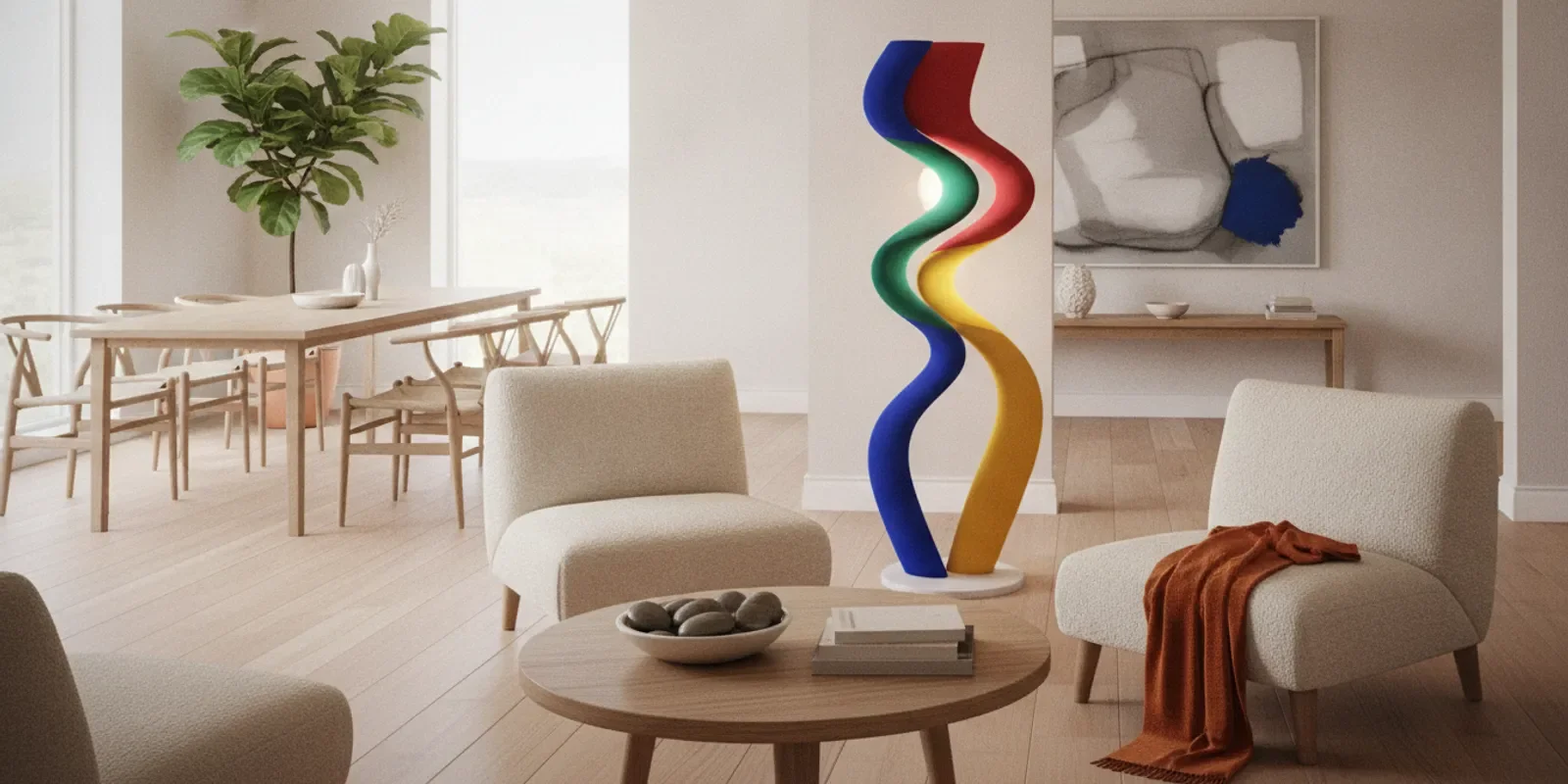
Think of the lamp as one part of a composition, not a zoning tool on its own. Furniture placement, a rug, the direction of seating, and the room’s existing light all contribute. A successful choice supports the purpose of the area instead of simply adding another object to a large room.
How do you choose a floor lamp for open concept room zoning?
Start by naming the zone you want to define and what people do there. A corner for conversation has a different job from a reading seat or a spot beside a sofa. Write down the purpose, the area’s boundaries, and how people move through it. Then evaluate each lamp against the room rather than choosing by appearance alone.
Define the zone. Identify the furniture that belongs together and the activity it supports. For example, a sofa and one or two chairs may form a conversation area, while a separate desk supports focused work.
Mark the boundary. Look at where a rug ends, where the seating changes direction, or where a natural walkway begins. Those edges can help you judge a useful lamp position.
Choose the lamp’s role. Decide whether it should be a visible sculptural marker, a source of light for a particular seat, or both. Do not assume every floor lamp has the same light direction or function; review the specific product details.
Check the view from the rest of the room. A lamp in an open plan is seen from multiple angles. Consider its shape against the sofa, dining area, and any clear sightlines.
Confirm practical details. Measure the intended spot, consider nearby routes, and check the product’s specifications, power compatibility, and delivery timing before ordering.
For a broader look at how separate fixtures can work together in connected living and dining areas, see our guide to mixing lamps in an open plan living and dining space. Here, the focus is narrower: using one floor lamp as a visual anchor for a defined area.
Where should you place the lamp in relation to the zone?
Begin with the furniture arrangement and place a potential lamp position on a simple room sketch. Mark the sofa, chairs, table, doors, windows, and the paths people use. Then test possible locations from more than one viewpoint. The goal is to connect the lamp to the intended area without making it feel like an obstacle or an unrelated object in the larger room.
A position beside or just behind a seating group can make the lamp read as part of that group. It may help visually frame a chair or the end of a sofa, depending on the fixture and room. If it sits too far away, it may appear to belong to another zone. If it crowds the furniture, the arrangement can feel cramped. There is no universal distance that works in every room, so use the furniture dimensions and clearances as your guide.
Keep circulation in mind. Trace the routes between the entry, kitchen, dining area, and seating. Avoid choosing a spot that interrupts a natural path, catches people as they move around furniture, or makes a frequently used door awkward to access. In a compact open plan, a few inches can change whether the lamp feels integrated or intrusive.
Try a temporary layout before you decide. Move a chair or side table slightly, or mark the lamp’s expected footprint with removable tape. Sit in the main seats and look toward the adjoining zones. Then walk the usual route through the room. This quick test can reveal whether the proposed position strengthens the seating group or simply adds another obstacle. It also helps you catch a sightline issue that may not be obvious from a plan or product photo.
Also consider what the lamp looks like from the other side of the room. In an open layout, a fixture can be visible from the dining table or kitchen as well as from the sofa. A sculptural form can serve as a deliberate visual punctuation mark. If the lamp’s shape competes with a strong view or another focal point, try a different position before settling on it.
What scale and silhouette suit an open room?
A wide, uninterrupted room can make a small fixture disappear, while an oversized form can dominate a more intimate seating nook. Judge scale in relation to the zone, not just the total floor area. Compare the lamp’s height and visual weight with nearby furniture, ceiling height, and the amount of open space around it. If you are unsure, tape out the approximate footprint on the floor and use a paper outline or a photo reference to imagine its vertical presence.
Silhouette matters because the lamp helps signal where one area begins. A floor lamp with a distinctive profile may create a stronger visual marker than a narrow, quiet shape. That does not mean the boldest option is always best. If the room already has prominent artwork, colorful furniture, or a dramatic pendant, a simpler form may support the composition. In a restrained room, a playful sculptural piece can add personality and give the seating area its own identity.
Look at the lamp from several angles and compare its lines with nearby forms. A rounded shade might soften a room filled with straight edges; a more vertical silhouette may echo tall windows or shelving. These are visual cues, not strict rules. The useful question is whether the lamp appears connected to its zone and balanced with the rest of the room.
Think about negative space as well as the object itself. An open plan room depends on visual breathing room between its areas. If the lamp, a tall plant, and a large chair all crowd the same edge, the boundary can become visually busy. If the zone feels too undefined, the lamp may be enough of a vertical cue to help, especially when it aligns with the edge of a rug or the end of a sofa. Take a photo from the room’s main entrance and inspect the composition. A phone photo flattens the view slightly, but it can make crowded or disconnected elements easier to notice.
For an example of how a statement fixture can anchor a seating area, explore the living room floor lamp focal-point guide. The room still needs to work first: the lamp should complement the way people use the area, not force an awkward layout for the sake of a photograph.
How should light direction fit the activity?
Think about the task and the atmosphere separately. A reading seat may need useful light in the immediate area, while a conversation zone may call for a softer overall feel. Check the product description for what the specific fixture is designed to provide. Do not infer the direction, brightness, dimming features, or adjustability from a lamp’s shape or from another model in the collection.
A floor lamp is one layer in a room, not necessarily the only source. Existing ceiling lights, table lamps, or other fixtures may already cover some needs. A lamp that marks a seating zone visually can still play a supporting role in the overall lighting plan. Take note of what the room feels like at the times you use it, then decide whether the new fixture needs to add a distinct source of light or primarily bring form and presence to the area.
Integrated LED is a product detail worth understanding before purchase. The Woaw Lighting Collection features integrated LEDs; review the relevant product page for the precise details that apply to your chosen fixture. For general background when comparing energy-efficient lighting, consult ENERGY STAR’s consumer lighting information. That broad reference does not replace checking the specification of an individual lamp.
What should you compare before you choose?
Use this table to compare the role you want the floor lamp to play with the questions that need answering. It is a planning aid, not a claim that one fixture type works for every room. Confirm dimensions, construction, light details, power compatibility, and timing on the specific product page before placing an order.
What to compareUseful questionWhat to checkZone purposeIs this for reading, conversation, or a visual boundary?Decide which activity matters most, then check whether the product details support that role.PlacementWill the lamp sit with the furniture without blocking movement?Measure the intended spot and trace the main routes through the room.ScaleWill it hold its own without overwhelming the seating area?Compare product dimensions with nearby furniture and the room’s open volume.AppearanceShould the lamp blend in or provide a sculptural accent?Look at its silhouette and finish alongside the room’s existing shapes and colors.ConstructionWhat materials and design details matter to you?Woaw fixtures pair steel bodies with ceramic shades; check the exact product listing for model details.PowerCan the fixture be used where you live?The collection is designed for universal 120V–240V compatibility with US, UK, and EU plug options; verify the details for your destination and product.TimingAre you comfortable ordering ahead?Woaw products are made to order and ship within two months; review the current pre-order information before purchase.
Which details matter when comparing floor and table lamps?
A floor lamp can establish a taller visual marker in a zone, while a table lamp is associated with a surface and may make more sense where a side table already belongs. The choice depends on the furniture, the amount of floor space available, and how prominent you want the fixture to be. Neither category is automatically better for an open plan room.
Consider the practical trade-off. A floor lamp occupies floor area and needs a suitable place within or beside the seating group. A table lamp needs a stable surface and a position that makes sense with the surrounding furniture. If you are deciding between the two categories, compare the Woaw floor lamps and Woaw table lamps, then inspect individual model details rather than assuming every fixture is interchangeable.
The Woaw range brings a playful, sculptural character to lighting, with steel bodies, ceramic shades, and integrated LEDs. Its bright color blocking reimagines traditional candelabra forms. That can be a point of contrast in a quiet room or one part of a more layered palette. The design choice should still relate to the zone: consider what the lamp looks like when the room is in use and from the other areas connected to it.
Color can help a zone feel connected or give it a deliberate point of contrast. Look at the colors already present in nearby textiles, artwork, and furniture. You might repeat a color that is already in the room, or choose one clear accent so the lamp reads as a purposeful feature. In a multicolor space, consider whether the fixture’s color blocking adds to the arrangement or competes with it. There is no required palette formula; the aim is to make the transition between living and dining areas feel considered rather than accidental.
Material also changes how a fixture reads, even when its color is quiet. Steel and ceramic offer a different visual impression from a fabric or plastic shade. Consider the materials already near the zone, such as wood furniture, metal hardware, or woven textiles. Repeating every material is unnecessary; one intentional contrast can keep the room from feeling overly matched. Use verified product details to understand the construction rather than relying on a photograph to identify a material.
Browse the Woaw Lighting Collection to compare the range, or look at the Woaw Triple Floor Lamp for an example of a specific floor-lamp listing. Use that listing for its product-specific information; do not assume its dimensions or details apply to another model.
What should you check before pre-ordering?
Before you commit, walk through the room once more and check the decision against real-life conditions:
Measure the location. Check the space where the lamp will stand and compare it with the product’s listed dimensions.
Test circulation. Make sure the intended position does not interfere with doors, paths, or everyday movement between zones.
Review the whole view. Consider how the lamp relates to the seating, dining area, and other visible focal points.
Read the exact product details. Confirm materials, dimensions, integrated LED information, and plug or voltage details for the model you are considering.
Plan for delivery timing. Woaw products are pre-ordered and ship within two months. Check the Pre-Order page for the current ordering path and details before making a decision.
Ask if a detail is unclear. Use the About page to learn more about the brand and its design approach, or contact the team with a question about a specific product.
A little planning can prevent the common mismatch of choosing a striking lamp before deciding where it belongs. Start with the zone, confirm the practical fit, then choose a form that brings the room together in your own way.
Explore the Woaw pre-order options
Frequently Asked Questions
Can a floor lamp separate areas without a wall?
Yes, it can help make an area feel distinct through its position, silhouette, and light. It does not create a physical boundary, so combine it with the furniture arrangement and other visual cues in the room.
Should the lamp go inside or outside the seating group?
Try both positions on a room sketch and compare the view and circulation. A lamp placed close enough to relate to the seating can help anchor it, but the best location depends on the furniture, available space, and route through the room.
How do I know what size floor lamp to choose?
Compare the listed dimensions with the seating, ceiling height, and available footprint. Measure the proposed location and consider the lamp’s visual weight from more than one viewpoint. Do not use a different model’s dimensions as a substitute.
Can I use a floor lamp as the only light in an open concept room?
Do not assume one lamp will meet every lighting need across a large, multi-use room. Consider the room’s existing sources and the activities in each zone, then review the specifications of any fixture you are considering.
A well-chosen floor lamp can give an open concept room a stronger sense of purpose while keeping its connected layout intact. Let the zone guide the placement, and let the product details guide the final choice.
