

Landscape lighting design ideas work best when they begin with what you want to notice after sunset, not with a list of fixtures. A thoughtful plan can make a path easier to read, bring a favorite tree into view, and give a patio a quieter sense of welcome. If you are also choosing a floor lamp for the room that faces the garden, keep the two jobs distinct: outdoor equipment must suit outdoor conditions, while an indoor lamp adds character to the room.
What should landscape lighting do?
Start by asking how you use the outdoor space at night. Do you need to find the front door, see a change in level, move between the house and a seating area, or enjoy a view of the garden from indoors? Each answer points toward a different lighting purpose. Writing those purposes down keeps the plan focused and helps distinguish useful light from decoration for its own sake.
Take a slow walk outside around dusk. Note where the route turns, where steps or edges are hard to distinguish, and where you naturally pause. Then look from the windows and seats you use most. A planting bed that feels important from the patio may disappear from the living room, while a nearby light source may reflect in the glass. Make a short list of the three most useful improvements before considering fixtures.
It can help to label each possible light by function: route, step, entrance, focal point, wall, or seating. If a proposed fixture has no clear job, leave it off the first draft. A small, deliberate arrangement often reads more clearly than a fixture at every dark patch.
Which landscape lighting design ideas make a useful starting point?
Landscape lighting design ideas are easier to compare when they respond to the shape of the site. Paths, planting, walls, and gathering areas each ask for a different effect. Treat these as options to test rather than a fixed recipe; placement, sightlines, the chosen equipment, and local requirements all matter.
Mark a route without making a runway
For a walkway, give people visual cues at turns, intersections, changes in level, and destinations. A few well-placed, shielded path lights may make the route legible without creating an unbroken row of bright points. Keep the source out of a person’s direct line of sight where possible. The useful question is not “How many lights can line the path?” but “Can someone see where to step and where the path leads?”
Steps deserve a close look. Check whether the tread and edge can be distinguished from the approach and from the side. A bright source aimed toward a person’s eyes may be distracting rather than helpful. If you test a fitting, walk the route from both directions and from the height of a seated visitor as well as a standing one.
Choose a focal point, then leave room around it
A tree with an expressive trunk or canopy can become a calm focal point. A controlled beam from a suitable outdoor fixture may reveal its form, but the light should serve the tree rather than draw attention to the equipment. Stand where you actually view the garden and see whether the beam makes the shape clearer. If the fitting itself is visible or the bright patch feels harsh, adjust its position, shielding, or angle.
One focal plant can be more effective than a row of individually lit shrubs. A group of grasses or shrubs may read as a single shape when illuminated gently, with nearby areas left unlit. This creates contrast and lets the eye move through the garden. Before adding another accent, ask whether it brings a new layer to the view or merely makes the scene busier.
Use walls to shape the view
A textured boundary, gate, or exterior wall can help define the outdoor room. A close, controlled beam can reveal texture; a softer wash may make a plain surface less prominent. The best effect depends on the surface and the angle, so judge it at night rather than assuming a daytime finish will look the same after dark.
Keep the light on the intended surface. Aim carefully, use shielding where appropriate, and check for spill toward windows, neighboring properties, and the open sky. Inspect the result from several viewpoints, including inside the home. What looks restrained beside the fixture can appear much brighter when seen from across the yard.
Give seating a different feeling from circulation
A patio route needs clear cues, while a place to sit often benefits from a softer atmosphere. Think about where people face and whether a bright source will shine into their eyes. A layered arrangement might rely on the home’s existing exterior light for orientation, with a restrained accent on a nearby feature. The goal is a comfortable place to talk, not a stage lit from every side.
How do you balance brightness and darkness?
Outdoor lighting is a composition of contrast. When every surface is equally bright, the eye has few places to rest and the landscape can feel flat. Choose a small number of areas for emphasis, then let the surrounding garden remain darker. Shadow is not a mistake to correct; it can give the illuminated parts shape and depth.
Think about the beam as well as the apparent brightness. A broad beam may spread beyond the feature you mean to show, while a narrow beam may miss it if the placement is wrong. Read the product information for intended use, light output, direction, shielding, and suitability for the location. Do not judge by a product photograph alone, since the actual view depends on the surface, distance, and surrounding darkness.
Color appearance affects how the scene feels. Consistent light tones in nearby areas can help the plan feel composed, while an abrupt difference may distract. Consider how the light looks against foliage, stone, painted surfaces, and the view through a window. If practical, test a sample or a temporary arrangement at night before buying several fixtures. Change one thing at a time—position, aim, or output—so you can tell which adjustment improved the view.
Controls may let you use different settings for arrival and for a quiet evening. A route light and a decorative accent do not always need to operate together. Timers, motion controls, or dimming may be options, depending on the equipment and installation. Check compatibility in the product documentation rather than assuming a control will work with every fixture.
How can you keep the plan considerate and practical?
Begin with where light should land. Aim it down or at the feature it serves, keep bright sources out of direct view when possible, and avoid sending beams above the target into open sky. Shielding and careful aiming can help control glare and spill. Review the scene from your property line and nearby windows as well as from the patio, because a setup can look different from each angle. For broader background on responsible outdoor lighting, see DarkSky International.
Use products explicitly designed and rated for the location and exposure. Indoor lamps are not outdoor fixtures. Follow the manufacturer’s instructions and applicable local electrical requirements. Have wiring and installation handled by a qualified professional when needed, and ask for clarification if the equipment rating or installation method is uncertain. This is especially important when work involves buried wiring, wet locations, or changes to an existing electrical system.Include maintenance in the plan. Plants grow and can block a beam; soil may shift; garden work can tilt a fitting. Keep product information and installation notes together, and make a note of the initial positions and aiming. Recheck the scene after planting changes or seasonal growth. Clean and service equipment only as the manufacturer directs, and use compatible replacement components.
What should you compare before choosing outdoor fixtures?
Compare candidates by the job they need to do rather than by brightness or appearance alone. These questions can help narrow the field:
Purpose: Is this for a path, a step, a focal feature, or a place to gather?
Beam: Will the light reach the intended surface without spreading into a window or the sky?
Glare: Can the source be shielded or placed outside the normal line of sight?
Suitability: Is the product specifically rated for the location and exposure?
Control: Does it work with the control method you plan to use?
Upkeep: Can it be reached safely for cleaning or adjustment?
Whole scene: Does it add a useful layer while preserving some darker areas?
Compare like with like. A route fixture and a narrow accent light have different roles, so a price or brightness comparison on its own says little about which is appropriate. Check the installation needs as well as the product details. If you are making a larger plan, review the view as a whole: existing porch lights, proposed fixtures, reflective windows, and dark spaces should all be considered together.
Where does an indoor floor lamp fit?
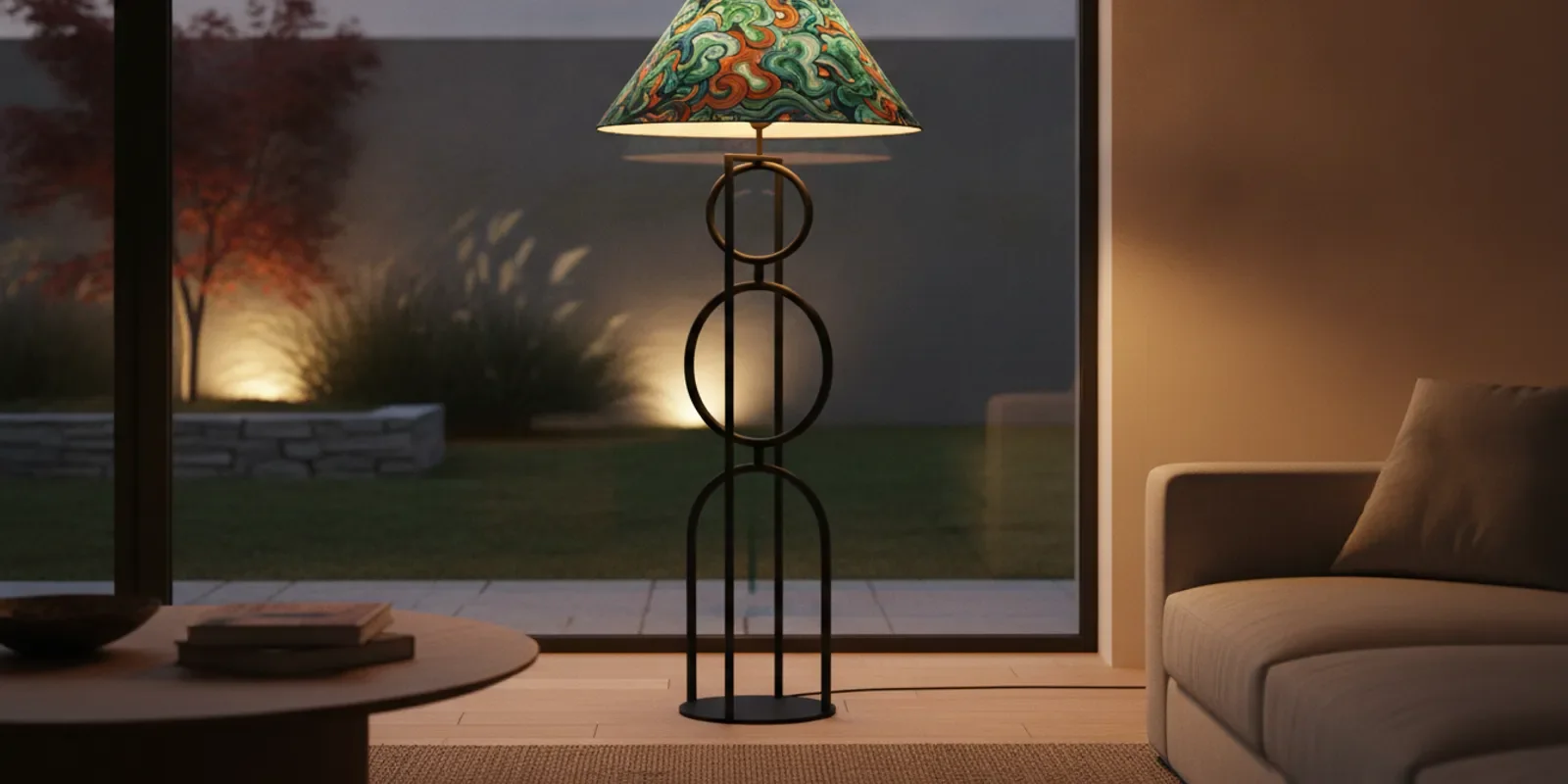
An indoor floor lamp does not replace landscape equipment. Keep it inside and use it according to its product instructions. It can, however, complement a garden view by making the room feel warm and intentional while the outdoor plan stays restrained. The two settings can share a mood without sharing fixtures.
Look at the room from the places where you sit and from the doorway. Notice whether a lamp’s silhouette will frame the view, compete with a tree outside, or create a reflection in the glass. A sculptural design can become the indoor focal point when the garden is quiet. If the landscape already has a strong feature, a simpler shape may give the eye more breathing room.
Scale and circulation matter. Measure the available footprint, note the path to doors and other furnishings, and consider how the lamp will appear from more than one angle. Do not choose a large form solely because it looks striking in a photograph; it needs to work with the room and its routes. For a broader discussion of the relationship between material and form, read our guide to steel and ceramic lamp construction.
Color and material can make a loose connection between the interior and garden. A bold color might echo a planter or artwork, while a ceramic shade can bring a softer surface into a room with metal or stone details. One repeated color or shape is often enough; exact matching is not necessary. Explore the Woaw floor lamp selection when you want to compare sculptural indoor forms.
What should you know before choosing a Woaw floor lamp?
Woaw lamps are designed for indoor use. The collection features steel bodies, ceramic shades, integrated LEDs, and universal 120V–240V compatibility with US, UK, and EU plug options. Check the information for the specific design and plug option before ordering. A floor lamp is a room-lighting choice, not a substitute for an outdoor-rated landscape fixture.Consider the design in context. If you want a floor lamp with a more prominent silhouette, compare the available forms and dimensions before settling on one. The Woaw Single Floor Lamp page is one place to review an individual design; use its current product details for the exact specifications.
Woaw lamps are made to order and ship within two months, so they are not ready-to-ship purchases. The stated current price range for floor lamps is $356–$491; check the product page for the current price of a specific design. Table lamps are a separate category, currently $282–$410. You can learn about the brand’s design approach on the About page, then review the ordering details before making a decision.
Before placing an order, confirm the lamp type and design you want, review the exact product information, and make sure the plug option suits your location. Allow for the made-to-order production and shipping window in your plans. If timing is important, read the current Woaw pre-order information rather than assuming an item is already in stock.
What is a practical way to plan landscape lighting?
A simple sequence can prevent impulse additions and make your choices easier to review.
Sketch the site. Mark the house, paths, steps, garden beds, seating, doors, and the windows from which you view the garden. Add existing exterior lights so new ideas are considered as part of the whole scene.
Observe it after dusk. Walk the route and note where you need a visual cue. Then view the garden from the patio and from inside. Record glare, reflections, and features you would like to see more clearly.
Set priorities. Choose a few goals, such as clarifying the entry route, revealing one tree, or making the patio feel welcoming. Do not try to solve every dark area in one pass.
Assign a purpose to each fixture. Label each proposed point by function. If two lights do the same job or a fitting has no clear purpose, remove it from the first draft.
Check equipment and installation. Confirm the product is rated for its location, review its beam and shielding, and follow the instructions and local requirements. Ask a qualified professional about electrical work or unclear specifications.
Test before expanding. If practical, try one or two fixtures in their intended positions. View them from the path, seating, street, and interior windows. Adjust only one variable at a time and check the result after dark.
Record and revisit. Keep notes about product choices and aiming. Recheck after plants grow or garden work shifts a fixture, and revise only when the scene or your needs change.
For example, imagine a compact garden with a short path, a single tree, and a small seating area. Start by identifying the point where the path changes direction and whether the tree is visible from the room. A modest route cue may solve the practical issue; one carefully aimed accent could reveal the tree. If the seating area is already comfortable under a nearby exterior light, adding several more fittings may not improve it. Test the two changes first, then decide whether anything else is missing.
This staged approach also helps separate outdoor choices from indoor shopping. Once the garden has a clear, restrained composition, consider whether a floor lamp in the adjoining room should echo the palette or act as its own focal point. Browse the wider Woaw Lighting Collection for indoor options that bring a playful design note to the room.
How do you make a confident choice?
Keep the outdoor brief focused on visibility, controlled beams, suitable equipment, and the character of the night. Keep the indoor brief focused on the room, the view, and the lamp’s scale and form. When the two decisions are treated separately, the result can feel connected without relying on an indoor product outdoors or over-lighting the garden.
If you are still deciding, return to your dusk walk and shortlist the changes that would make the clearest difference. Test a small number of outdoor lights, preserve areas of shadow, and review the exact product details for any indoor lamp you consider. A considered choice should solve a real need and feel right from the viewpoints that matter to you.
Explore the Woaw pre-order options
Frequently Asked Questions
Can I use an indoor floor lamp outside?
No. An indoor floor lamp is not a substitute for equipment rated for outdoor conditions. Keep indoor products indoors and select fixtures designed for the installation location.
How many lights should a landscape plan include?
There is no single number for every property. Start with the route and features that matter most, test the effect after dark, and add a fixture only when it improves visibility or the overall view.
Should path lights line both sides of a walkway?
Not necessarily. A few well-positioned, controlled lights near turns, steps, or destinations may provide useful cues without creating a runway effect. Walk the route and check for glare before deciding to add more.
Are Woaw floor lamps outdoor lights?
No. Woaw floor lamps are designed for indoor use. They feature steel bodies, ceramic shades, and integrated LEDs; review the individual product information for details before ordering.
The most successful landscape lighting plan makes the route clear, gives a few features room to shine, and lets the rest of the night remain part of the design.
