

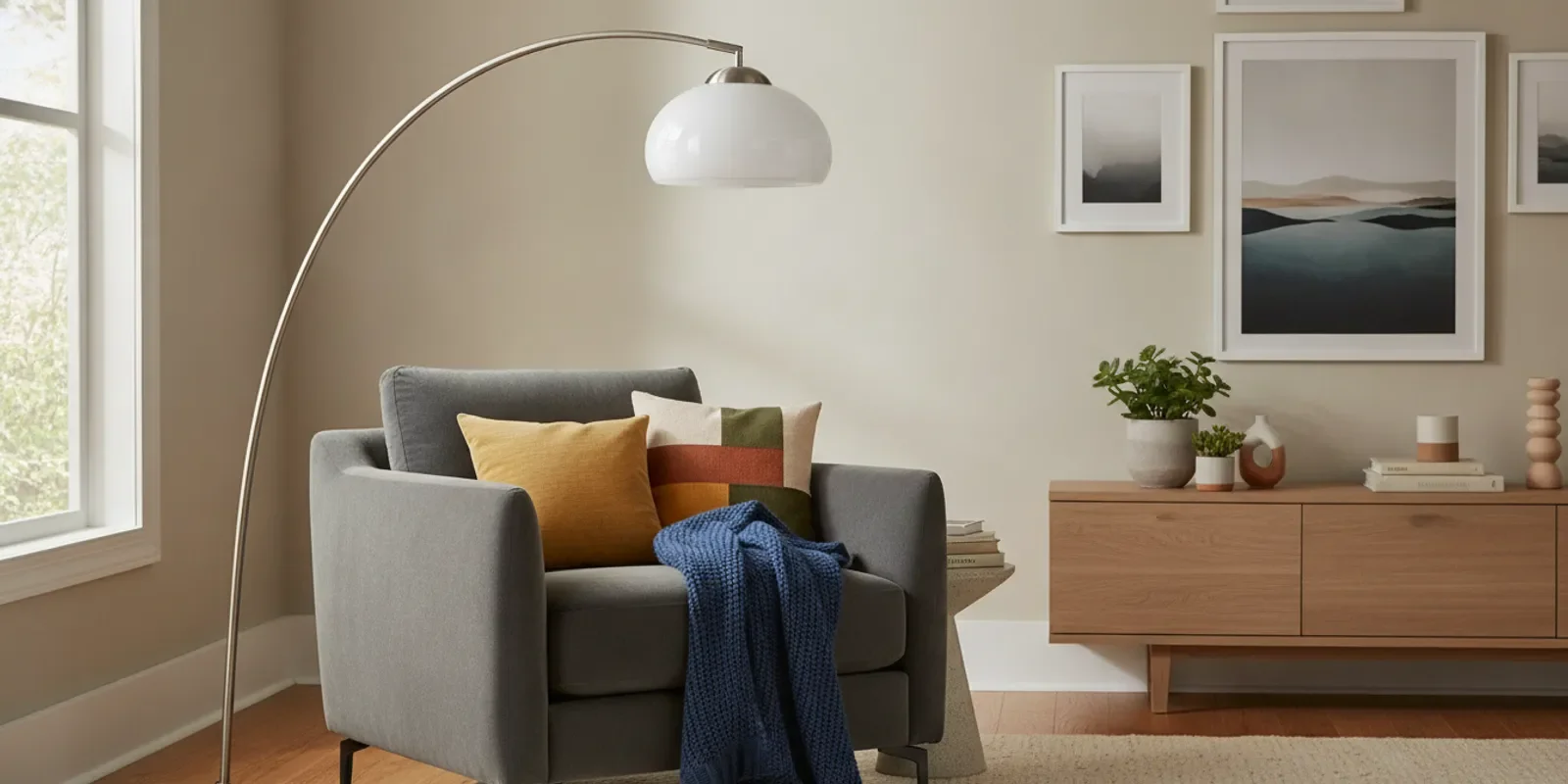
Arc lamp cord length is the length of cable between the lamp and the plug, not the reach of the curved arm. A long arm can put light over a chair while the cord still falls short of the nearest outlet. Measure the real walking path from the base to the wall, then add slack so the plug is never pulled tight.
Explore the Woaw lighting collection
What does arc lamp cord length actually describe?
Two measurements get mixed up in product photos. Reach is how far the arm carries the light away from the base. Cord length is how far the plug can travel from that base to a receptacle. A dramatic curve does not add inches to the cable.
Read the listing for a stated cord length before you fall in love with a silhouette. If the page does not list it, treat that gap as a question for the maker, not as a guess. Some arc floor lamps ship with a long cord, around the length of a small room. Others ship with a short lead meant for an outlet directly behind the furniture.
The base position decides the starting point. Tuck the base behind a sofa and the cord may only need to reach the wall a short distance away. Place the same lamp beside a chair in the middle of a seating group and the cable has to cross open floor. The lamp did not change. The route did.
How do you measure arc lamp cord length before you buy?
Use a cloth tape, not the arm's published projection. Start where the cord leaves the base in the spot you actually plan to use. Follow the path the cable will take, along the floor and the wall, and stop at the outlet face. That number is the minimum. It is not the length you should shop for.
Add slack in three places. Leave a gentle loop where the cord exits the lamp so the base can shift a few inches during cleaning. Leave enough at the plug so it seats fully without strain. Leave a little extra if the sofa might move forward for vacuuming. A cord that only just reaches will pull out the first time someone nudges the lamp.
Write the result in feet and compare it with the product's stated cord. If the maker does not publish a number, ask before you order. Do not plan on a later extension as the design. The U.S. Consumer Product Safety Commission says extension cords are for temporary use, and it warns against running them under carpets, through doorways, or under furniture.
Mark the path, then walk it
Lay painter's tape or a strip of paper along the proposed route. Walk past it with the lights on and again at night. If your foot catches the tape, a cord in that line will catch a foot too. Move the base, or choose a closer outlet, until the taped line sits against the wall or behind furniture.
Count every turn. A cord that runs six feet in a straight line on a floor plan can need eight once it follows a baseboard around a table leg. Measure the bends. Straight-line math is how a "long enough" cord arrives an arm's length short.
Measure twice, once with the furniture where it lives and once with it pulled out for cleaning. The second number is the one that matters on laundry day. If you only measure the tucked-in position, the cord will be tight every time you vacuum behind the sofa.
Note which side of the base the cord leaves. A lead that exits on the left cannot use a tidy right-side route without crossing the front of the lamp. Turn the base in the taped outline and see where the cable wants to go. Buy for that exit, not for the exit you wish the lamp had.
Which cord length fits each placement?
There is no single correct length. The right cord is the one that covers your measured route with slack and still lies out of the walking path. Use the table as a planning range, then replace the range with your own tape measurement.
Base placementTypical route.Planning range.Watch for.Behind a sofa, on the wall.A short baseboard run.6 to 8 feet.Cord pinched by the sofa.In a corner by a chair.Along two walls.8 to 12 feet.A bend that pulls the plug.Beside a bed or chair.Behind the furniture.8 to 12 feet.A cord in the night path.Open floor, off the wall.Across open floor.Longer than stock.Trip line. Move the lamp.
A published length near 11 feet is common on some arc floor lamps and covers many behind-the-sofa setups. It does not cover a base parked in the center of a large room. If your tape says 14 feet, an 11-foot cord is the wrong product for that spot, not a cord you should stretch.
Shorter can be better. Extra cable has to live somewhere. A 15-foot cord behind a sofa that sits two feet from the outlet becomes a coil you trip on while reaching for a book. Match the cord to the route instead of buying the longest one in the category.
Write the outlet height into the measurement too. A receptacle just above the baseboard adds almost nothing. One mounted mid-wall adds the vertical rise, and a cord that is pulled upward will slowly walk the plug out of the socket. Measure to the actual face of the outlet, not to a dot on the floor.
Keep this decision separate from how the lamp looks over the sofa. Reach, shade height, and visual scale belong in a styling pass. Cord length is a different question: can the plug arrive at a real outlet without crossing a walkway?
How should you route the cord once it is long enough?
A cord that is long enough can still be a poor route. Run it along the baseboard, behind the sofa, or under the back edge of a console that does not pinch it. Clip it so it cannot wander into the room. Leave it visible enough that you can inspect it.
Do not hide it under a rug. Covered cord can be walked on, furniture can crush it, and damage is easy to miss. The Consumer Product Safety Commission specifically says not to run extension cords under carpets or under furniture. Treat the lamp's own cord with the same care. Heat and foot traffic are not kinder to a factory lead.
Keep the cable away from door swings, radiator covers, and the track of a sliding door. A door that closes on a cord will cut the jacket over time. If the only outlet sits on the far side of a doorway, that outlet is the wrong one. Pick another placement.
Slack is a feature, not leftover wire
Coil extra length once, loosely, behind the base or along the wall. Do not wrap it tight around the lamp stem, and do not knot it. A tight coil traps heat and makes the plug easier to yank. A single loose loop lets you pull the sofa out and put it back without unplugging.
Check the plug after the furniture is in its final place. It should sit straight in the outlet, with the face of the plug against the wall plate. If the cord is holding the plug at an angle, the route is too short. Move the lamp closer or choose a nearer outlet.
Look at shared outlets before you commit. A receptacle already crowded with a router and a speaker may not accept the lamp plug without a splitter stacked on the wall. Stacked plugs stick out, and a cord pulled sideways from a stack is the same strain problem as a short cord. Free a socket or use the next outlet down the wall.
If children or pets use the room, keep the visible run behind furniture rather than along an open baseboard at floor level. A dangling loop is a toy. Clip the cable flat, and leave no slack low enough to chew or tug. That is a routing choice, not a reason to hide the cord under a rug.
What should you do when the cord is too short?
Move the lamp before you shop for a longer cord. A base a foot closer to the wall often solves the gap and improves the walking path at the same time. If the light no longer lands where you want it, the arm reach and the cord length are in conflict. That is a placement problem, not a reason to stretch the cable.
An extension cord is a temporary bridge, not the design. If you use one while you decide, choose a cord listed by a recognized laboratory such as UL, ETL, or CSA, and match it to a light fixture rather than to a high-wattage appliance. Unplug it when you are not using the lamp. Do not run it under a rug, through a doorway, or under a chair.
The better permanent fixes are simple. Use an outlet that already sits on the lamp's wall. Ask an electrician about adding a receptacle behind the sofa if this is a long-term home and the cord would otherwise cross the room. Do not cut the lamp cord, splice on a household extension, or tape a damaged jacket. The Commission warns against altering a cord's length or repairing insulation with tape.
Measure the real route from the cord exit to the outlet, including every baseboard turn.
Add slack for a cleaning shift and a plug that is not pulled tight.
Compare that total with the maker's stated cord length before you order.
Move the base if the cord would cross open floor or a doorway.
Skip a permanent extension and add an outlet if the gap remains.
Which electrical details belong with the cord decision?
Cord length does not tell you whether the lamp is safe to plug in. Read the voltage, the plug type, and the light source on the product page. A long cord on the wrong plug is still the wrong lamp for the room.
Woaw floor lamps are specified for universal 120V to 240V use, with a choice of US, UK, or EU plugs. The Woaw floor lamp pairs a steel body with a ceramic shade and an integrated LED. Confirm the plug that matches the country where the lamp will be used. A travel adapter is not a substitute for the correct plug, and it does not add cord length.
For a closer look at voltage and plug choices on a related lamp type, read the universal-voltage lamp guide. Use it for the electrical idea, then return to the floor lamp's own page for the cord and plug on the piece you are ordering. Table-lamp guidance does not set the cord length of an arc floor lamp.
Also look at where the switch sits. A switch on the cord is useful only if you can reach it without fishing behind the sofa. A switch on the stem is easier when the base is tucked away. Neither detail changes the measurement, but both change whether the route you chose is pleasant to live with.
Inspect the jacket before the first use and again when you rearrange the room. Nicks, flat spots, and a warm plug are reasons to stop using the lamp and contact the maker. Do not wrap tape around a cut and keep going. A damaged cord is a replacement issue, not a styling issue.
Keep liquids off the route. A plant tray or a drink on the floor beside the base is a spill waiting for the plug. Run the cable where a watering can will not empty onto it, and do not let the cord sit in a window track that fills with rain. Dry routing is part of the length plan.
How does cord planning fit a sculptural floor lamp?
A sculptural lamp still has to reach an outlet. Plan the cord first, then enjoy the shape. If the only beautiful spot leaves a cord across the rug, it is not the right spot yet.
The Woaw collection is a line of steel-and-ceramic lamps with integrated LEDs, built as playful statement pieces rather than as a set of classic arc lamps. The Woaw buying guide walks through the forms. Use this article for the cord route, and that guide when you are comparing silhouettes. Do not assume a compact floor lamp and a long-reach arc share a cord length.
Current floor-lamp pricing in the collection runs from $356 to $491. Pieces are made to order and ship within two months, so confirm the live price and the lead time on the pre-order page before you commit. A cord you have already measured is easier to live with than a rush decision that ignores the outlet.
If you want a general method for choosing any floor lamp by height and task, the floor lamp selection guide covers that broader decision. Come back here when the open question is the cable, not the shade.
Review pre-order details for Woaw
Frequently asked questions
How long is a typical arc lamp cord?
Many arc floor lamps ship with a cord around 8 to 12 feet, and some makers use about 11 feet. That is a category pattern, not a promise. Measure your route and read the listing. If the length is missing, ask before you buy.
Can I use an extension cord with an arc lamp?
Only as a short-term bridge. Use a listed cord, keep it uncovered, and unplug it when the lamp is off. For a permanent setup, move the lamp closer to an outlet or have a receptacle added. Do not run any cord under a rug.
Should the cord run under the sofa?
Along the wall behind the sofa is fine if nothing pinches it. Under the sofa, where feet and the frame can crush it, is not. Leave the jacket visible enough to inspect, and keep the plug straight in the outlet.
Does a longer arm mean a longer cord?
No. Arm reach and cord length are separate specs. A lamp can throw light far into the room and still have a short lead. Measure from the base, not from the shade.
What if I rent and cannot add an outlet?
Place the base on the wall that already has a receptacle, and accept a slightly different arc. A furniture arrangement that hides a cord across the room is not a safe workaround. A listed power strip at that existing outlet is still temporary equipment, not hidden wiring.
Measure the path, add slack, and choose the lamp whose cord matches that route. The curve can be bold. The cable should be boring, short on drama, and long enough to reach the wall without a tug.
