

A floor lamp for a narrow living room can add a clear point of focus without making the room feel crowded. The key is to plan around how people move through the space, then compare the lamp’s footprint, silhouette, light direction, and relationship to nearby furniture. A little measuring and a temporary placement test can tell you more than a product photo alone.
Ask us about choosing a floor lamp
What makes a narrow living room challenging to light?
A narrow room gives each object a more visible role. A lamp that might fade into a larger room can become a focal point here, while a bulky base or an awkwardly positioned cord can interrupt the route between the entrance, seating, and other parts of the home. The answer is not automatically to avoid floor lamps. It is to look at the room as a plan, not just a collection of furniture.
Start by noting the room’s main walking line. This is the route people use most often, such as the path from a doorway to a sofa or through to another room. Mark it on a quick sketch, along with doors, windows, seating, side tables, and outlets. Then identify the parts of the room that feel underused or visually unbalanced. A lamp may work at the edge of a seating area, at the far end of a sofa, or in a corner that needs a deliberate design feature—but the right spot depends on the actual layout.
Do not assume the narrowest corner is the best spot. A lamp can be visually attractive there but still obstruct a door, crowd a seat, or put a cord across a route. The practical test is whether the lamp can have a defined place without forcing people to change how they move through the room.
How do you choose a floor lamp for a narrow living room?
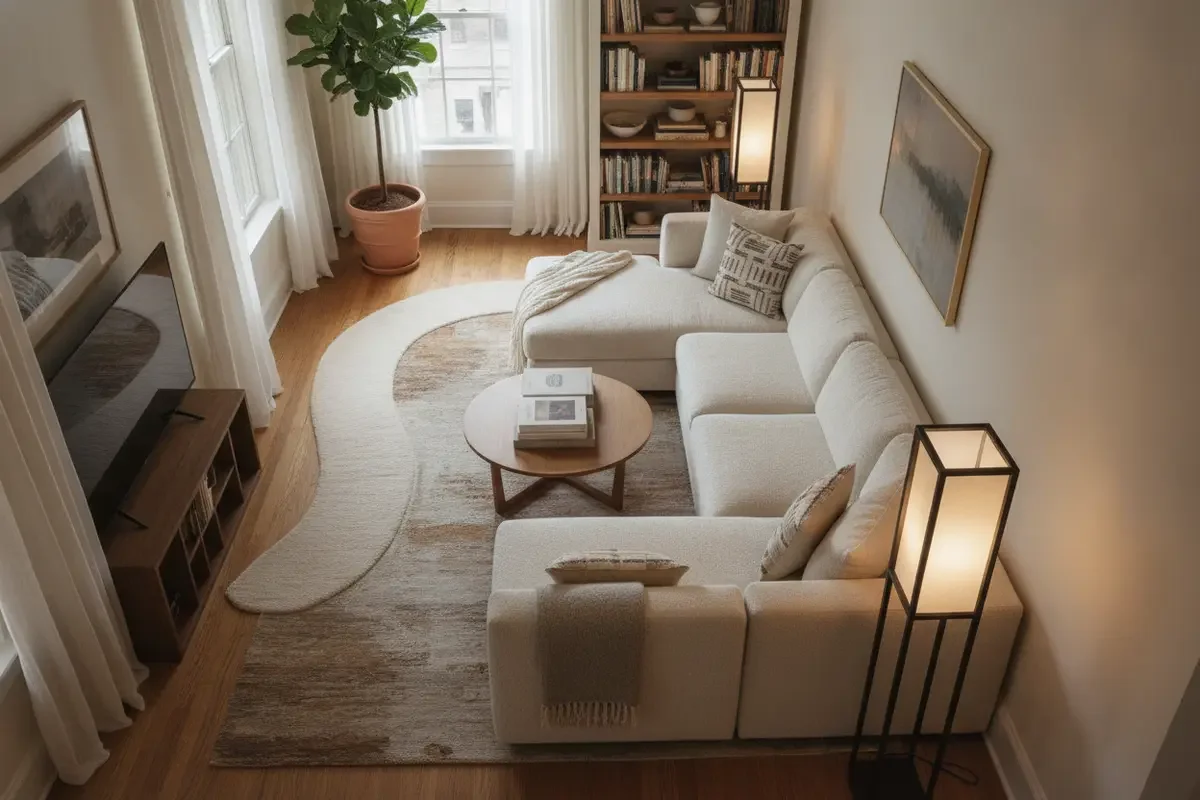
Sculptural floor lamp and compact sofa shown together to compare their visual scale

Evaluate the lamp and room together. Measure the candidate area, consider the shape of the base and body, and judge the lamp against the furniture around it. Product dimensions matter, but they are only part of the picture: a slender-looking lamp may still have a base that needs more floor space than expected, and a tall sculptural form may draw the eye more strongly than a modest silhouette.
Measure the available zone. Write down the width and depth beside the sofa, chair, or wall where you might place the lamp. Include room for the furniture already there and for normal movement. Compare those measurements with the product dimensions on its page; if the details you need are not listed, ask before placing an order.
Map the walking route. Trace the common path across the room. Check door swings and the way people approach seating. A lamp should not turn a direct route into a squeeze or sit where it is likely to be bumped.
Look at the base and profile. Consider what the base occupies on the floor and how the lamp’s body rises above it. A visually open profile may feel lighter in a tight room, while a bold sculptural form can create an intentional focal point. Neither is universally better; compare it with the other shapes and colors in the space.
Check the light’s intended use. Think about whether you want a welcoming glow near a seating area, a practical pool of light for a particular activity, or a decorative accent. Review verified product information rather than assuming that a lamp’s appearance tells you how its light is directed.
Test before committing to a position. Use painter’s tape to mark the footprint on the floor, or temporarily place a similar object there. Walk past it from different directions and sit in nearby seats. The test will not reproduce the lamp’s full visual effect, but it can reveal a route or furniture conflict.
For more context on how floor and table lamps can serve different needs, see this table lamp versus floor lamp guide. It can help you decide whether a floor-standing piece is the right way to add light in the first place.
Where should the lamp sit in relation to the seating?
Think in terms of zones. In a living room, the seating group is often one zone, while a doorway or the route through to another room is another. The lamp should support the seating zone without taking over the path. Common positions to test include beside one end of a sofa, next to a chair, or behind the outer edge of a seating arrangement. Treat these as starting points, not fixed rules: furniture size, outlets, windows, and traffic patterns change what works.
If a side table already occupies the end of the sofa, compare whether a floor lamp would add useful height or simply add another object to the same crowded spot. A table lamp may be a better alternative when the surface and arrangement allow it. If the sofa sits against a wall, check that the lamp does not block access to curtains, switches, or other features. If the furniture floats away from the wall, study the lamp from the entry and the main seat so it looks intentional from both views.
Also consider the cord path. Keep it out of the main walking line and avoid stretching it tightly across a doorway or under a moving chair. Follow the product’s instructions for electrical setup, and make sure an appropriate outlet is available where you intend to use the lamp. If the only outlet forces a cord into an inconvenient route, choose another position or ask about your options rather than treating the route as a minor detail.
A useful visual check is to take a photograph from the room entrance and another from the seat where you spend the most time. In both images, ask whether the lamp belongs to the arrangement, whether the room still feels easy to cross, and whether it competes with a feature you want to notice. These simple views can make a placement decision clearer than standing right beside the lamp.
Which lamp shape and scale suit the room?
Scale is about more than height. Compare the lamp’s base, shade, body, and overall silhouette with the sofa, chairs, and nearby tables. A very small fixture may disappear beside substantial furniture; a visually complex one may become the room’s main event. In a narrow living room, choosing deliberately matters because there are fewer places for the eye to rest.
Decide whether you want the lamp to blend in or stand out. A restrained profile can support a calm arrangement. A sculptural fixture can bring character to a simple room, especially when its colors connect to a cushion, artwork, or another object already present. For an easy starting point, choose one feature to echo—shape, material, or color—rather than matching every item. The goal is a relationship, not a set that looks overly coordinated.
Look at the lamp from several angles. A piece that seems narrow in a straight-on product image may have a broader footprint or more visual mass when seen from the side. Check the maker’s dimensions and product views, and do not rely on an image to establish exact scale. If a particular dimension is important to the placement, verify it directly before ordering.
For a broader look at how a sculptural lamp can act as a defining object, read what makes a lamp a statement piece. If the challenge is a specific shadowy corner rather than the room’s overall layout, the guide to choosing a floor lamp for a dark corner explores a related question from that angle.
How should light direction and layers affect your choice?
One lamp rarely has to do every job in a living room. A room may use general light, a closer light for reading or another task, and accent light that draws attention to an object or area. Think about what is missing in your room before selecting a fixture. If the ceiling light already handles general illumination, a floor lamp may serve a more specific visual or seating purpose. If the room feels flat at night, consider how a lamp will work alongside existing table or wall lighting.
Do not assume all floor lamps deliver the same kind of light. A shade and bulb arrangement influences how light is experienced, but use the product information to understand the actual fixture. Check whether the light source is integrated or replaceable, how the lamp is operated, and what information is provided about brightness or color. If those specifics are not available, ask the seller rather than inferring them from the style.
For a general reference on planning lamps and their placement, see South Dakota State University Extension’s table lamp design resource. Its guidance is a starting point, not a formula for every room: the right arrangement depends on your furnishings, activities, and available space.
When testing a location, switch on the other lights you use in the evening. Notice whether the floor lamp adds a useful layer, creates an unwanted reflection, or leaves the activity area darker than you intended. This is especially useful in a narrow room, where the same fixture can be seen from several adjoining spaces. Consider the view from each of those spaces rather than judging only from directly in front.
What should you compare before choosing?
Use the table below to compare the options by purpose and practical checks. It is not a ranking: the best choice depends on the room’s route, existing lighting, and the way you use the seating area.
Option or positionCould suit you when…Check before decidingFloor lamp beside the end of a sofaYou want a vertical feature close to the seating zone.Base footprint, sofa access, cord path, and whether the spot is already busy.Floor lamp near a chairYou want to make a chair feel like a distinct part of the room.Space to approach and leave the chair; confirm the lamp’s light is suitable for the intended activity.Floor lamp at a room edge or cornerYou want to draw attention to an underused area or add a sculptural accent.Door and curtain movement, outlet location, and whether the lamp is visible from key viewpoints.Table lamp on an existing surfaceYou prefer to keep the floor clear and already have a suitable table.Available surface area, stability, cord route, and how the lamp relates to nearby seating.No additional lamp yetYou are unsure whether the room needs another fixture.Try changing the arrangement or using existing lights before buying; identify the actual lighting gap.
To see the brand’s current floor-lamp range, visit the Woaw floor lamp page. The wider Woaw Lighting Collection lets you compare the broader range, while the Woaw Triple Floor Lamp product page is one specific product detail page to review. Always use the current product information for dimensions and features before deciding what suits your layout.
What details matter when comparing a narrow-room lamp?
Once you have a possible location, confirm the practical details—not just the photograph or the color. The Woaw Lighting Collection features steel bodies, ceramic shades, integrated LEDs, universal 120V–240V compatibility, and US, UK, and EU plug options. Check the individual product listing for details that apply to the specific fixture you are considering, including its measurements and available plug selection.
Material and form are part of the room’s visual balance. Steel and ceramic bring different textures and visual weight than a lamp made entirely from a lightweight-looking material. In a compact space, those details can make the lamp feel more like a designed object than a background accessory. Think about how the shade and body relate to the colors and surfaces already in the room, without assuming that any material is automatically right for a particular style.
Ordering timing matters, too. Woaw fixtures are made to order and ship within two months; they are not presented as ready-to-ship items. Review the current Woaw pre-order information before purchase so you understand the ordering path. The page is also the place to start if you are ready to compare fixtures and proceed with a pre-order.
If you are still deciding between a floor lamp and a smaller fixture, compare the space each option uses as well as the light you need. A table lamp can keep the walking surface free when you already have an appropriate table; it also introduces a different silhouette and height. A floor lamp offers a separate vertical form but needs a considered location on the floor. Look at the room’s complete arrangement, not one specification in isolation.
Explore the Woaw lighting collection and pre-order options
Frequently Asked Questions
Can a floor lamp work in a narrow living room?
Yes, if you can give it a defined spot without disrupting the room’s main walking route. Measure the space, check the lamp’s footprint, and test the location before ordering. If every possible position feels crowded, consider a table lamp on a suitable surface or another lighting arrangement.
Should I put a floor lamp behind the sofa?
It can be one position to test, but it is not right for every layout. Check whether there is room behind the sofa, whether people can still pass comfortably, and whether the cord can reach an outlet safely. Consider how the lamp looks from the entrance and from the seating area, then compare it with a position at the sofa’s outer end.
What should I measure before ordering?
Measure the available floor area where the lamp may sit, note nearby furniture and door movement, and map the walking path. Compare your measurements with the product’s listed dimensions. If a needed dimension or feature is not clear, contact the seller before making a decision rather than estimating from photographs.
How do I keep a lamp from making a small room feel busy?
Give the lamp a clear role, such as supporting a seating area or acting as a focal object. Avoid placing it where it overlaps visually with several other prominent items, and keep the main route easy to read. A single intentional accent often feels more considered than adding several objects to the same tight area.
How long does a Woaw pre-order take?
Woaw lighting is made to order and ships within two months. Review the current ordering details before placing a pre-order, and check the product page for the specific fixture’s verified features and dimensions.
The best floor lamp for a narrow living room is the one that suits your lighting needs, feels at home with the room’s proportions, and leaves everyday movement comfortable. Measure first, test the placement, and confirm product details before choosing.
