

Searching for the best minimalist floor lamps 2024 can mean looking for a quiet silhouette, a useful pool of light, or a single object with enough personality to anchor a room. The right choice balances all three with your space and routine. Start by deciding what the lamp needs to do, then compare scale, shape, materials, and ordering details rather than choosing by appearance alone.
Explore the Woaw Lighting Collection
What should a minimalist floor lamp do in your room?
Minimal does not have to mean invisible. A lamp can use a restrained outline and still become the room’s most memorable object. Before browsing, name its main job. Is it meant to add a layer of light near seating, bring visual height to an empty stretch of wall, or introduce a considered color accent? A clear purpose makes comparisons easier.
Think about the room at the time you will use it. A corner beside a reading chair calls for a different light direction than a spot intended to create atmosphere across a living area. Notice existing ceiling and table lighting, too. A floor lamp usually works best as one part of a layered plan, not as a vague fix for every lighting need.
For a reading routine: prioritize a shade and position that direct light toward the activity without forcing an awkward posture.
For ambient presence: consider how the lamp’s shade and form will read when the fixture is switched on and off.
For a visual anchor: look for a silhouette that relates to the room’s furniture and palette rather than competing with every other focal point.
Write down the intended role in one sentence. “A sculptural accent beside the sofa” is more useful than “something for the corner.” It gives you a filter for both function and form.
How do you evaluate the best minimalist floor lamps 2024?
Use the same criteria for every option. A polished product photograph can make almost any lamp look right; a simple comparison helps reveal what fits your home. Consider the lamp’s footprint, overall height, shade orientation, materials, electrical compatibility, and purchase timing. If a detail is not stated on the product page, ask before ordering rather than filling in the blank yourself.
Start with proportion. Measure the floor area available and note the nearby furniture height. A tall, narrow profile can feel visually light, while a broader or multi-arm design has more presence. Neither is automatically better. The aim is a balanced relationship: the lamp should be visible from the room’s main viewpoint without obstructing a path or making the seating feel crowded.
/
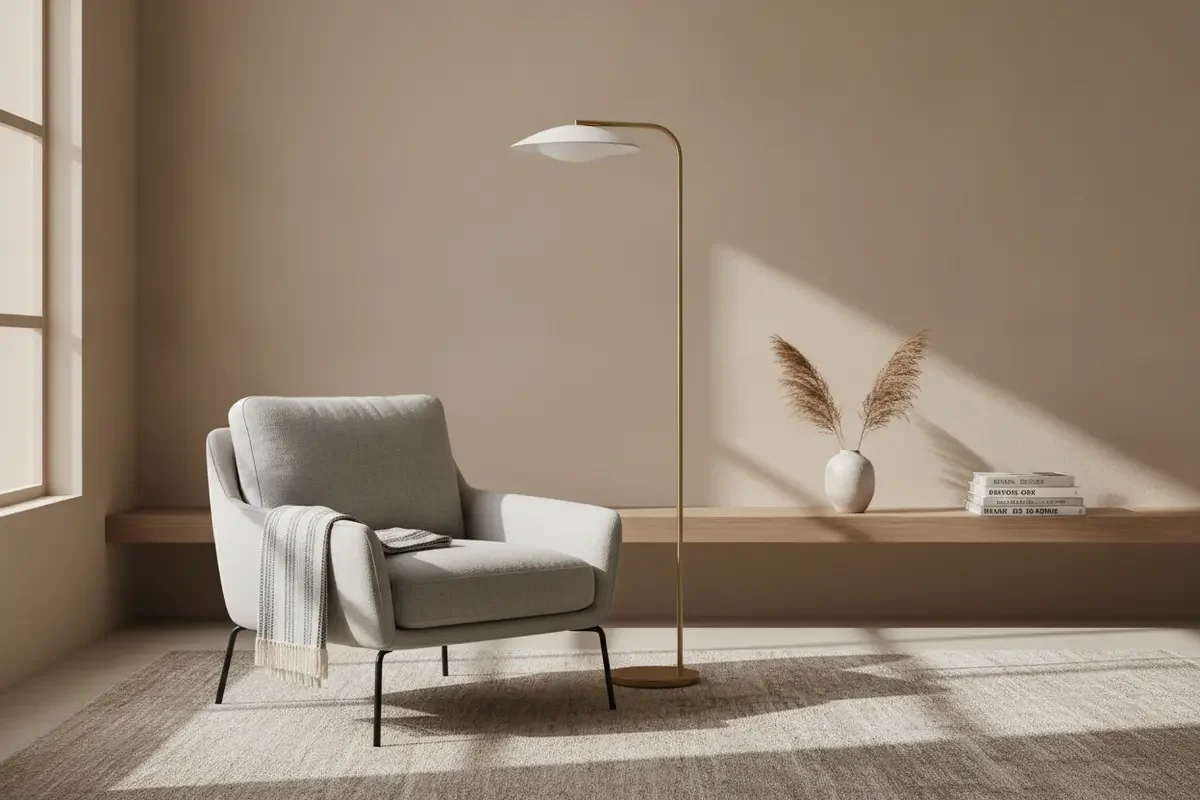
Floor lamp silhouette shown beside a lounge chair for scale
Which silhouette and scale feel balanced?
Look at the outline before considering color. Ask whether the shape is straight, curved, branched, or composed of repeated forms. A simple vertical line can reinforce a calm interior. A sculptural branching form can add rhythm while keeping the surrounding furniture understated. The most successful pairing is not necessarily the one with the least detail; it is the one whose detail feels intentional in context.
Measure the intended position. Mark the base footprint on the floor with painter’s tape and check the path around it. Then view the proposed height against a nearby chair, sofa, or console. If possible, use a temporary vertical marker to judge how the form will sit within the room. These quick checks catch scale mismatches before an order is placed.
Also consider what the lamp looks like from more than one angle. A floor lamp is a three-dimensional object, not a flat picture. In an open room, people may see it from the side or behind. A sculptural design should make sense from those viewpoints, especially if it will sit near a walkway or at the edge of a seating arrangement.
Check the base as carefully as the upper structure. A visually delicate stem can still have a wide footprint, while a branching shape may project into the room beyond the base. Compare the product’s stated measurements with the taped outline, and leave enough room for doors, drawers, and everyday movement. If the dimensions are not easy to find, pause and request them instead of estimating from a styled photograph.
Finally, compare height against the visual line of nearby objects. A shade that sits much lower than a chair back can feel tucked away; one that rises well above the surrounding furniture can become a deliberate vertical accent. There is no universal ideal height. What matters is whether the silhouette appears intentional from the places where you actually sit and walk.
How should light direction fit your routine?
Shape alone does not tell you where light will fall. Check the product description for the shade arrangement and the stated light source. Decide whether you want light directed toward a task, diffused into the room, or visually expressed through the fixture. Avoid assuming brightness or dimming performance unless the product information confirms it.
For a reading position, think through the complete setup: where you sit, which hand you use, where the book or device rests, and whether the shade can direct light toward that area. For a more atmospheric role, ask how the lamp will contribute alongside overhead lighting and smaller table lamps. A layered room can feel more considered when each source has a distinct job.
Mr. John’s Goods’ Woaw Lighting Collection uses integrated LEDs. That is a verified collection feature, but it does not by itself answer every question about brightness, control, or suitability for a particular task. Check the exact product information for the specific performance details that matter to you.
Try a simple room audit before choosing. At the time of day you expect to use the lamp, switch on the existing lights and note where shadows fall. Is the reading surface dim, or does the room feel flat despite having enough light? That observation helps you decide whether the new fixture should contribute focused light, a softer background layer, or mainly a sculptural presence. Be precise about the problem; “more light” can mean several different things.
Think about glare and sightlines as well. A shade positioned toward a seat should not shine directly into your eyes, and the lamp should not interrupt the view across a room. Product photographs can suggest orientation, but they do not replace model specifications. If adjustability is important, confirm that the selected design actually offers it rather than inferring movement from the shape.
Where possible, compare the lamp in both daytime and evening conditions. In daylight, its outline and color may matter most; after dark, the distribution of light becomes more noticeable. A design that looks pleasing while switched off should still contribute appropriately when illuminated. Keep the room’s existing sources in the picture, since the goal is a coordinated layer rather than a solitary fixture doing every job.
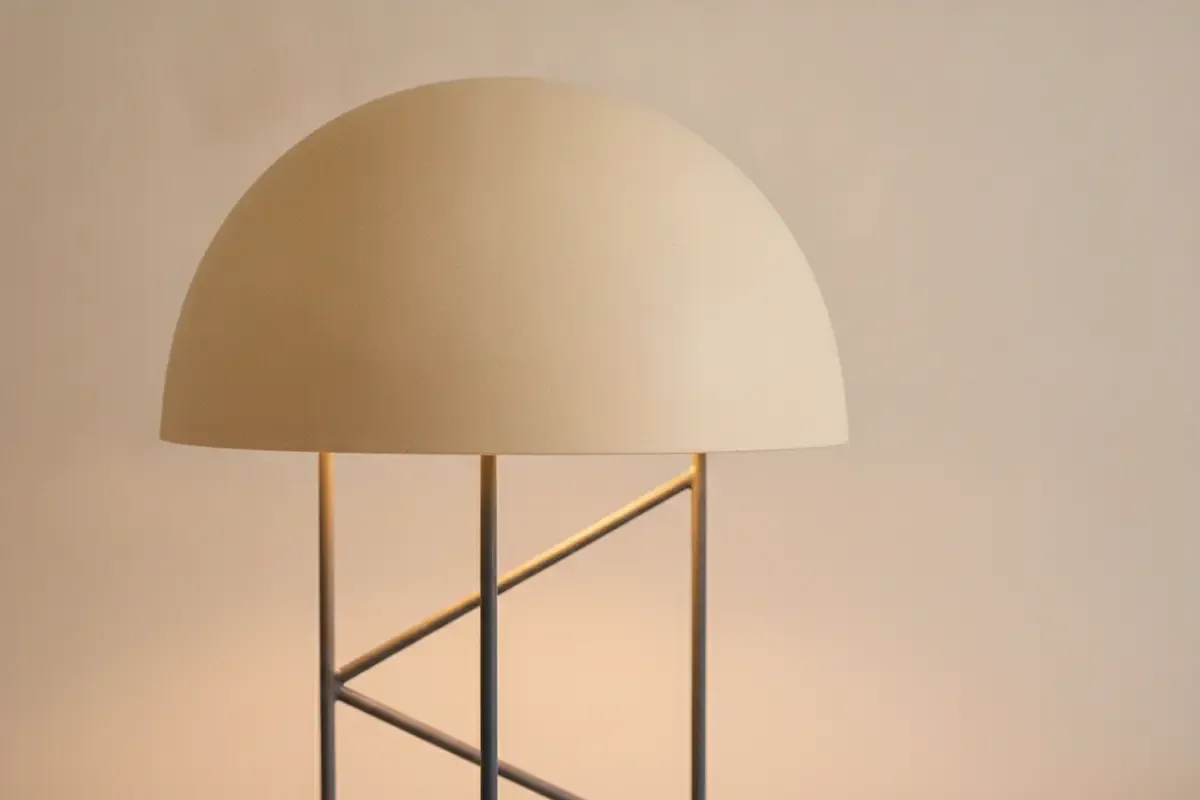
Ceramic shade and steel structure shown in close detail
What materials and construction details are worth comparing?
Materials affect the way a lamp looks and feels in a room. Compare the shade and body separately, then consider how their finishes work together. A ceramic shade can bring a substantial, tactile quality; steel can give a body a crisp, structured outline. Look closely at the joins, finish, and balance of the object in product imagery, and seek clarification on any detail that is important to your decision.
The Woaw collection pairs steel bodies with ceramic shades and reimagines traditional candelabra forms with bold color blocking. Its design is playful, but the material combination and sculptural structure give it a deliberate presence. That can suit a room where the larger furnishings stay simple and one expressive object does the talking.
Care matters as well. Follow product-specific instructions rather than applying a general cleaning method to a finish or shade. Consider whether the product page explains care and replacement components, and keep those details with your order information. If long-term upkeep is a deciding factor, contact the brand to confirm what is supported for the exact model.
When comparing finishes, look at color in relation to the room rather than in isolation. A bold shade can echo one small detail, such as a book spine or artwork accent, without requiring a full color scheme built around it. If the room already has several saturated objects, a lamp with a quieter surrounding palette may feel more integrated. The point is not to match every item but to create one or two visual connections.
Inspect the object’s visual balance in product images: how the shade meets the body, whether the structure seems coherent, and how the finish changes across its surfaces. Close-up photographs can help, but ask for clarification if an important construction detail is unclear. Do not assume that similar-looking models have identical finishes or components; compare the exact item you are considering.
What should you compare before choosing?
A short comparison table can keep a lovely silhouette from distracting you from practical questions. Use it as a checklist, then fill in the details from each product page. The Woaw column below includes only confirmed collection information; details not specified here should be checked for the individual lamp.
Decision point — What to check — Woaw collection information
Form and footprint — Overall outline, base dimensions, available floor area, and walking clearance — Multiple sculptural floor-lamp forms are offered; check the selected product page for dimensions.
Materials — Shade and body materials, finish, and visible construction — Steel bodies and ceramic shades.
Light source — Whether the source is integrated or replaceable and any stated performance details — Integrated LED; confirm model-specific details on the product page.
Electrical fit — Voltage range and plug option for the destination country — Universal 120V–240V compatibility and US, UK, and EU plugs.
Price and timing — Current price, payment terms, production window, and delivery information — Floor lamps are listed within the $356–$491 range in the verified product facts; made-to-order production takes about 60 days.
Make the table useful by adding your own priorities. A shopper furnishing a compact reading corner might rank footprint, light direction, and lead time above color. Someone finishing a calm living room might give silhouette, shade material, and visual presence more weight. Score each shortlisted model against the same criteria, then note any unanswered question beside it. This prevents a strong first impression from hiding an important practical mismatch.
You can also separate “must fit” criteria from “would be nice” criteria. Electrical compatibility, available floor space, and an acceptable production window may be non-negotiable. A particular color or silhouette may be flexible. This distinction helps when no option is perfect: first eliminate choices that fail a requirement, then compare the remaining designs on character and preference.
What electrical and ordering details matter?
Check compatibility for the country where the lamp will be used. The Woaw collection is described as compatible with universal 120V–240V power and offered with US, UK, and EU plugs. Confirm that the option selected at checkout matches your destination and review the specific product page if your circumstances are unusual.
Then look at the purchase model. Woaw is made to order, rather than presented as ready to ship. The stated production window is about 60 days, so allow for that when planning a room refresh, move, or gift. The model involves full payment upfront before manufacturing begins, according to the available company information. Read the current ordering and delivery terms before committing, since these practical details are part of the product decision.
For floor lamps, the verified price range is $356–$491. Treat that as a category range, not a promise that every model costs the same. Check the selected product’s current price and any relevant shipping or return terms directly before ordering.
For background on reliable residential lighting, the U.S. Department of Veterans Affairs’ Design Guide for Inpatient Mental Health & Residential Facilities discusses lighting fixtures in residential settings; its guidance is specific to those settings, so apply it only where relevant and consult product specifications for your own needs.
Before checkout, make a small “order readiness” list: destination country, preferred plug, model-specific dimensions, current price, production window, payment terms, delivery expectations, and return conditions. This is especially helpful when the lamp is intended for a date-specific occasion. A made-to-order item requires planning, so treat the production window as part of the timeline rather than an afterthought. The pre-order information page is the right place to review the current process; confirm that the terms still match your expectations before paying.
Do not compare only the headline price. Consider whether the total fits your budget and whether the stated timeline suits your plans. If a detail such as delivery timing or an electrical option matters and is not clear, ask before placing the order. A quick clarification is more useful than an assumption that later changes your decision.
How can a sculptural lamp stay minimalist?
Minimalism is often about editing, not stripping a room of character. Choose one strong shape, then give it space. Keep nearby surfaces relatively calm, repeat one of the lamp’s colors elsewhere in a small way, or let the rest of the palette remain neutral. This helps a distinctive lamp feel connected to the room rather than dropped into it.
Scale the surrounding objects with care. A visually intricate lamp can sit comfortably among plain forms; several competing statement pieces may make the room feel busy. Conversely, a simple room can benefit from a lamp with a more playful outline. Think of contrast as a design tool: restrained architecture and lively lighting can make each other clearer.
For inspiration on how a light can act as an anchor, explore this guide to using a floor lamp as a living-room focal point. If you are deciding between formats, compare the considerations in the table lamp versus floor lamp guide as well.
Use color with intention. One vivid lamp can enliven a neutral room, but it need not dictate every other choice. Consider repeating its color in a modest object on a shelf, a piece of art, or a textile. Alternatively, let the lamp be the sole saturated element so the eye has a clear point of focus. Both approaches can feel minimalist when the rest of the composition is edited.
Look at the room from the entry and from the main seat. A lamp that feels bold up close may read as a calm vertical accent from across the room. If its form competes with a strong artwork or a busy patterned rug, adjust the surrounding objects or choose a different position. This is a useful reminder that minimalism is a relationship between objects, not a rule that every object must be plain.
How can you make a confident shortlist?
Shortlist no more than a few options and score each against your actual priorities. A quick rating from one to five works well, provided you score the same criteria every time. For example, someone seeking an expressive accent might give silhouette and color more weight, while a reader may care most about light direction and placement.
Measure the proposed location and note the available clearance.
Describe the lamp’s intended job in a sentence.
Compare silhouette, scale, materials, and shade arrangement.
Verify electrical compatibility and the details you need for daily use.
Review current price, payment, production, delivery, and return information.
Choose the option that meets the practical requirements and feels right in the room.
For further context, browse the Woaw Lighting Collection, read about the brand’s design approach and background, or see the stockists page to explore listed retail partners. If you need a specific detail clarified before choosing, use the contact page.
One practical method is to make a three-column note: “confirmed,” “needs checking,” and “personal preference.” For example, you may have confirmed the lamp uses an integrated LED, still need to confirm the dimensions, and simply prefer one color over another. Keeping these categories separate makes the decision clearer and prevents aesthetic preference from being mistaken for a product specification.
Give the shortlist a final real-room test. Stand at the doorway, sit in the intended seat, and walk the route around the proposed footprint. Imagine the lamp both switched off and in use. If the form feels right from those viewpoints, the light role is appropriate, and the order details fit your schedule, you have a stronger basis for choosing than a product image alone can provide.
How can Woaw fit your decision?
Woaw may suit shoppers who want the clarity of a considered, sculptural object without treating minimalism as synonymous with plainness. The collection combines steel bodies, ceramic shades, integrated LEDs, universal voltage compatibility, and playful forms inspired by candelabras. It is made to order, so the production window and payment terms should be part of your decision from the start.
Compare the individual floor-lamp designs and confirm their current specifications rather than assuming every model has identical dimensions or light behavior. If the silhouette, materials, electrical option, and lead time all fit your needs, the collection offers a distinctive route to adding personality with a single light.
Before buying, review model-specific information and the current pre-order terms. The floor-lamp category includes a range of forms and prices, so choose by the details that matter in your room, not by a generalized promise about every design. A measured, informed choice can make a playful statement feel at home in a restrained space.
Frequently Asked Questions
What makes a floor lamp minimalist?
Minimalist floor lamps typically use a clear silhouette and avoid unnecessary visual clutter. They can still use expressive color or sculptural forms; the key is how thoughtfully those details work with the room.
Are Woaw floor lamps ready to ship?
No. Woaw lighting is made to order, with an approximately 60-day production window. Review the current ordering and delivery details before placing an order.
What materials are used in the Woaw collection?
The collection uses steel bodies and ceramic shades. Check the individual product information for model-specific specifications.
Will a Woaw lamp work with power outside the United States?
The collection is described as compatible with 120V–240V power and US, UK, and EU plugs. Confirm the plug option for your destination before ordering.
The best minimalist floor lamp is the one that earns its place through proportion, useful light, thoughtful materials, and a form you will enjoy seeing every day.
